


How Smart Transformers Enable Renewable Energy Grid Integration
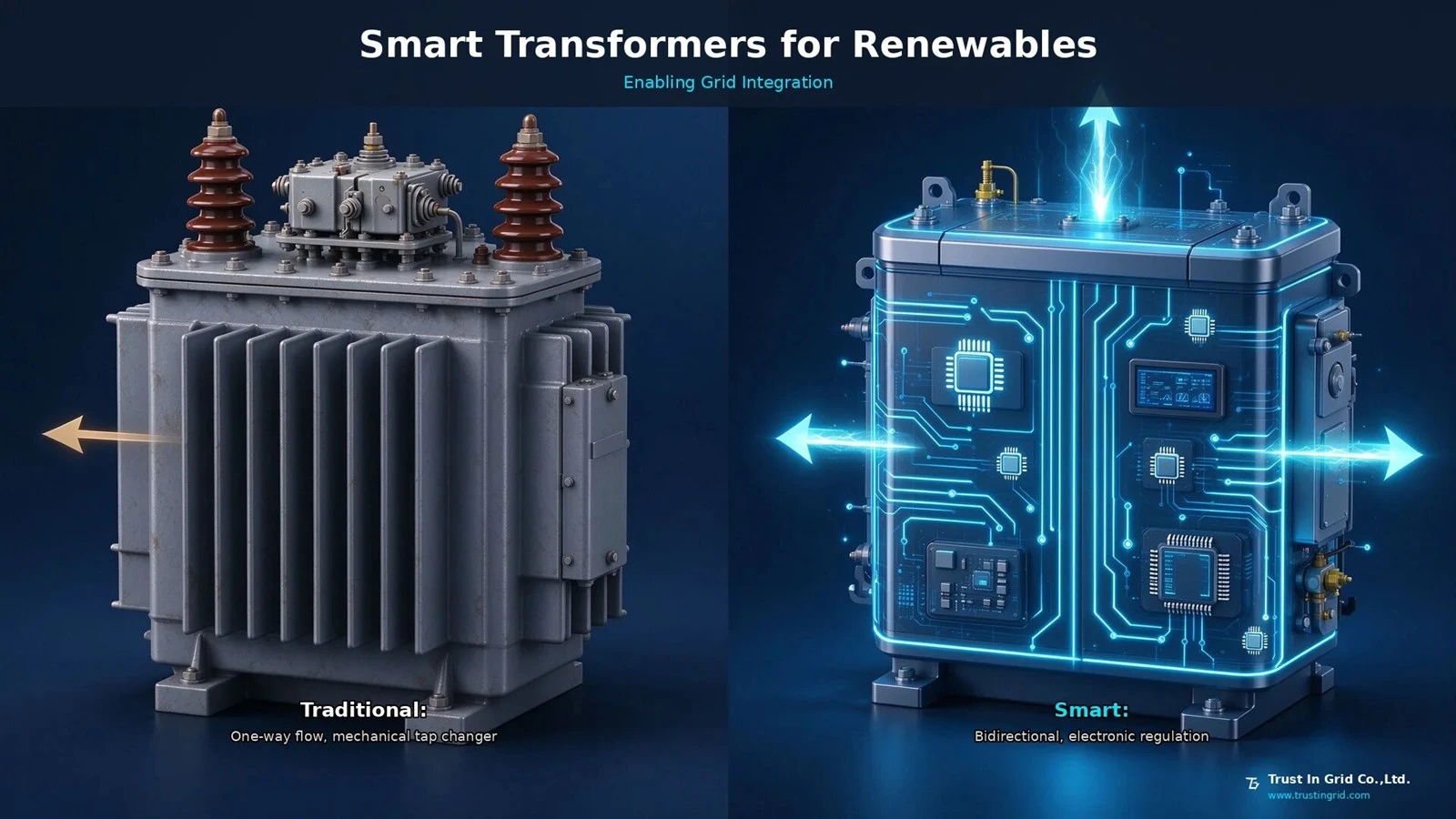
The hardest problem with renewable integration isn't generating enough power. It's that the grid doesn't want to cooperate. Solar and wind output follow the weather. Traditional transformers just step voltage up or down, taking whatever comes at them. If voltage drifts, a mechanical tap changer slowly cranks it back. Smart transformers change the logic: they don't just transform voltage. They regulate it, handle bidirectional flow, and monitor their own health.
Here is what they actually do, and when the extra cost makes sense.
1. Why Standard Transformers Fall Short
Distribution grids were built for one-way traffic: substation to load. Add rooftop solar, and power starts flowing backward. Standard transformers don't have a playbook for reverse power. Voltage at the point of common coupling creeps up, and inverters either trip offline or curtail output. Wind is worse. Minute-by-minute output swings leave mechanical on-load tap changers (OLTC) choking.
OLTCs aren't new. But high renewable penetration exposes their weaknesses. Mechanical contacts are slow, they wear out, and they need maintenance. Solar-induced voltage fluctuations can happen in seconds. Smart transformers swap mechanical action for electronic control, dropping response times from seconds to milliseconds.
2. What "Smart" Actually Means
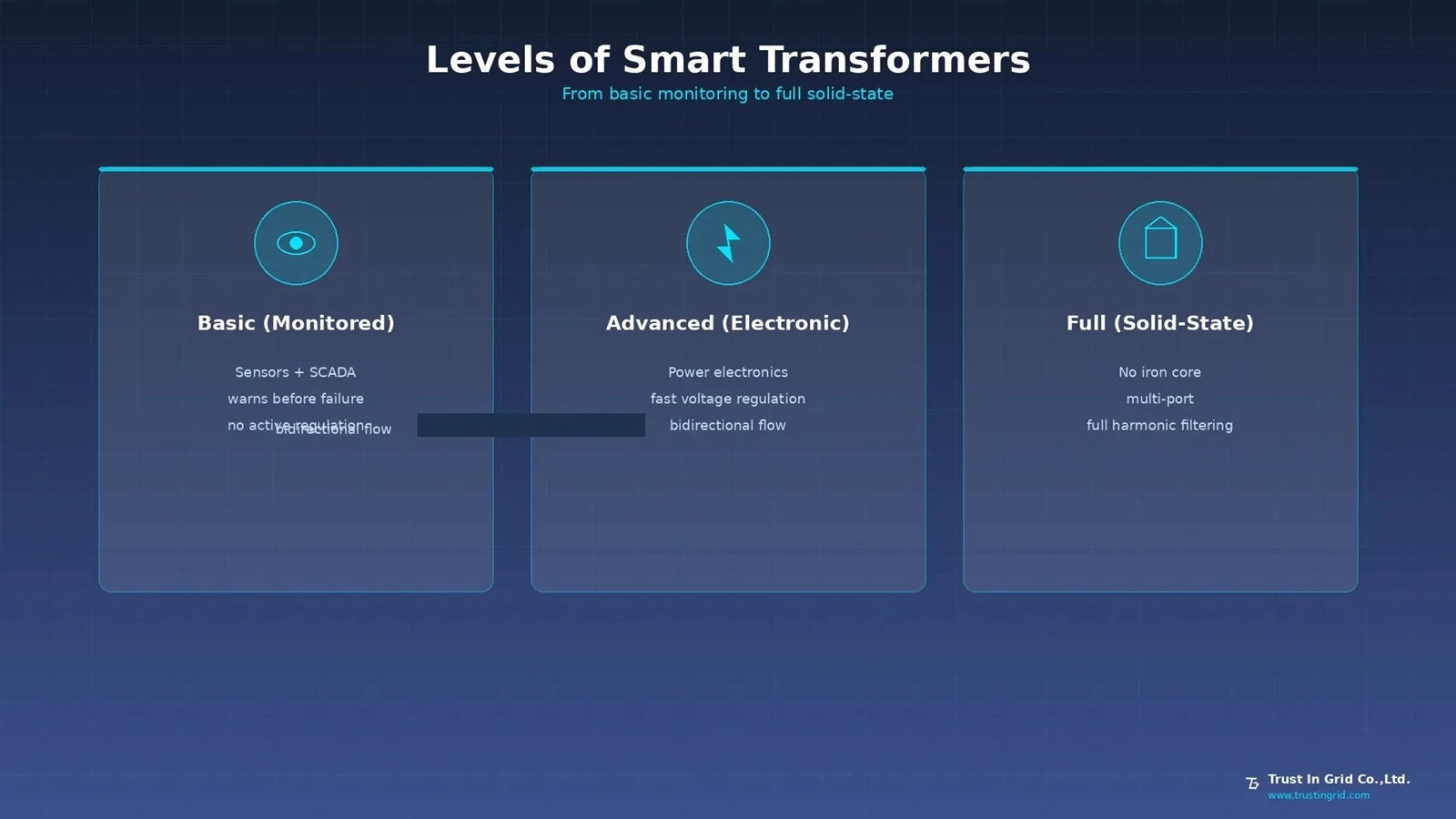
The industry throws the term "smart transformer" around loosely. Sometimes it means a standard unit with sensors. Sometimes it means a solid-state transformer (SST). Sometimes it means a multi-port design. The functional differences are huge, so read the spec sheet carefully.
Basic: Monitored Transformer. Add temperature, partial discharge (PD), and voltage/current sensors. Push data to the SCADA system via IEC 61850. It warns you before a failure, but it cannot actively regulate voltage. Low cost adder, good for retrofits.
Advanced: Electronically Regulated Distribution Transformer. Uses power electronics instead of mechanical taps, or adds a smart terminal to control the tap strategy. Actively manages voltage swings from solar and handles bidirectional power flow. This is the realistic upgrade path for most solar-heavy distribution networks today.
Full: Solid-State / Multi-Port Transformer. Replaces the iron core entirely with power converters, or uses a multi-port structure tying AC grid, PV DC, storage, and loads together. It gives you full bidirectional control, reactive power compensation, harmonic filtering, and islanding. Expensive. Mostly for pilot projects and microgrids right now.
Most projects asking about "smart" are looking at the advanced version. The full SST is the future, but not yet mass-market.
3. Core Functions
Bidirectional Power Flow. When solar pushes power back at noon, standard transformers weren't designed for the flux and loss distribution of that reverse flow. Smart transformers support it at the control level, preventing protection relays from tripping when energy feeds back to the MV side. For high-penetration PV areas, this directly sets your grid-connection capacity limit.
Dynamic Voltage Regulation. Voltage at the PV connection moves with sun, wind, and load. Smart transformers adjust the ratio or inject reactive power in milliseconds to hold it in the compliant band. Studies show electronic regulation hits a higher voltage compliance rate than mechanical OLTCs under heavy distributed energy penetration.
Harmonics and Power Quality. Inverters generate harmonics, and multiple inverters on the same line make it messy. The power electronics stage of a smart transformer can actively filter, keeping THD within limits. Solid-state units are best at this. A standard transformer with a smart terminal can only watch the problem, not fix it.
Condition Monitoring and Predictive Maintenance. This is the most underrated feature. Online DGA, fiber-optic temperature sensing, and PD monitoring shift you from "fix it when it breaks" to "replace it before it breaks." For offshore or remote sites, this value beats voltage regulation any day.
4. Data Comparison
| Feature | Standard + Mechanical OLTC | Smart Transformer (Electronic/Monitored) | Solid-State / Multi-Port |
|---|---|---|---|
| Regulation Response | Seconds, mechanical | Milliseconds to seconds, electronic | Sub-millisecond |
| Bidirectional Flow | Passively absorbs | Voltage-level management | Fully active control |
| Harmonic Mitigation | None | Monitoring only | Active filtering |
| Condition Monitoring | Periodic offline tests | Online sensors + remote comms | Integrated diagnostics + predictive |
| Reactive Power | Needs external capacitor banks | Limited | Built-in |
| Cost Premium | Baseline | Moderate (~10–30%) | High (several times baseline) |
| Best Fit | Low renewable penetration | High-penetration PV distribution | Microgrids, multi-energy sites |
5. Standards and Interfaces
A smart transformer's brain depends on communication. IEC 61850 is the core substation automation protocol, defining data models for transformers, breakers, and protection devices. The smart terminal has to speak this protocol to integrate with grid monitoring systems.
IEEE 2815-2024 is the specific standard for smart distribution transformer terminals, covering functions, communication interfaces, hardware platforms, and environmental requirements. When specifying, confirming the terminal meets this standard matters more than staring at the transformer's nameplate. If the terminal is incompatible, data goes nowhere, and the "smart" features are dead weight.
6. Where It Makes Sense
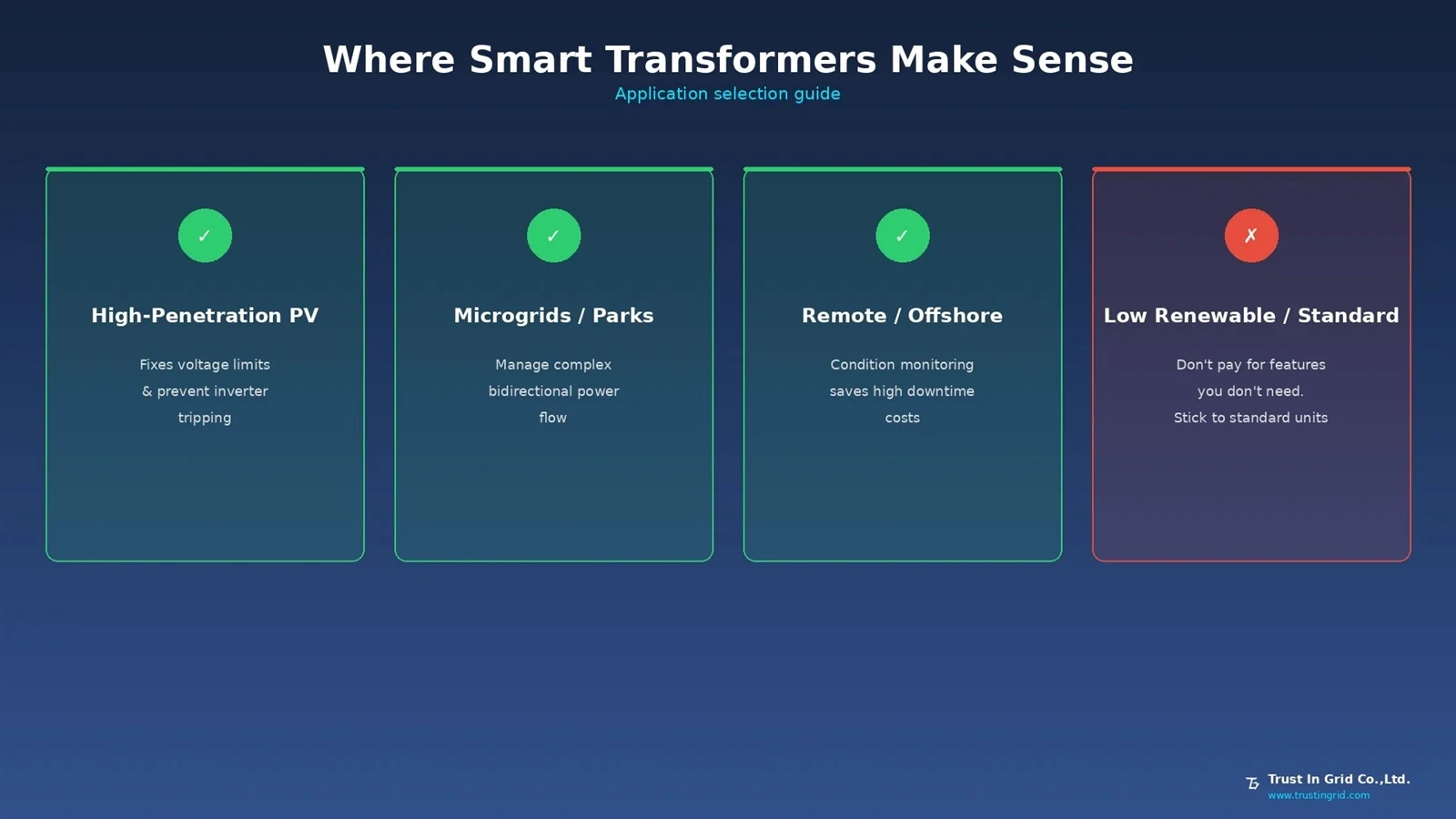
High-penetration PV distribution areas. If voltage limits are constantly tripping inverters offline, electronic regulation or a smart terminal is the most direct fix. Moderate cost premium, fast payback.
Parks or microgrids with bidirectional metering. Solar, storage, and EV chargers mixed together make power flow complicated. A smart transformer's bidirectional management and multi-port capability match this perfectly.
Remote or offshore sites. High maintenance costs make condition monitoring and remote diagnostics worth more than voltage regulation. The downtime cost of one failed transformer easily dwarfs the smart terminal premium.
Standard outdoor distribution, low renewable penetration, no voltage issues. A standard transformer with periodic testing remains the cheapest option. You won't use the smart features, so don't pay for them.
We build transformers and supply core materials. If you are evaluating transformer specs for a renewable project-voltage regulation needs, bidirectional requirements, monitoring interface, or core grade-send us the details. Voltage level, application, renewable mix, volume, timeline. You will get a straight answer.
TIG - Trust in Grid
www.trustingrid.com
asia@trustingrid.com
References
[1] Multiport Smart Transformers: A Review of Architectures, Applications, and Future Trends, IEEE Industrial Electronics Magazine, 2025.
[2] IEEE 2815-2024, IEEE Guide for the Technical Specification of the Smart Distribution Transformer Terminal, IEEE Standards Association, 2025.
[3] IEC 61850-7-1:2003, Communication networks and systems in substations – Part 7-1: Basic communication structure, IEC, 2003.
[4] Applications and Challenges of On-Load Tap Changing Technology for Distribution Transformers in Scenarios with High Penetration of Distributed Energy Resources, ScienceDirect, 2026.
[5] Ancillary Services of A Triple-Port Smart Transformer, IEEE Xplore, 2025.