


Transformers For Solar Farms: Step-Up Solutions For Utility-Scale PV Projects
Picking a transformer for a solar farm is not the same as specifying one for a standard distribution network. The inverter spits out power at 690V or 800V. The grid needs it at 10kV, 35kV, or higher. That step-up transformer handles every megawatt the plant produces. A fraction of a percent in efficiency loss adds up to real money over a 25-year lifespan.
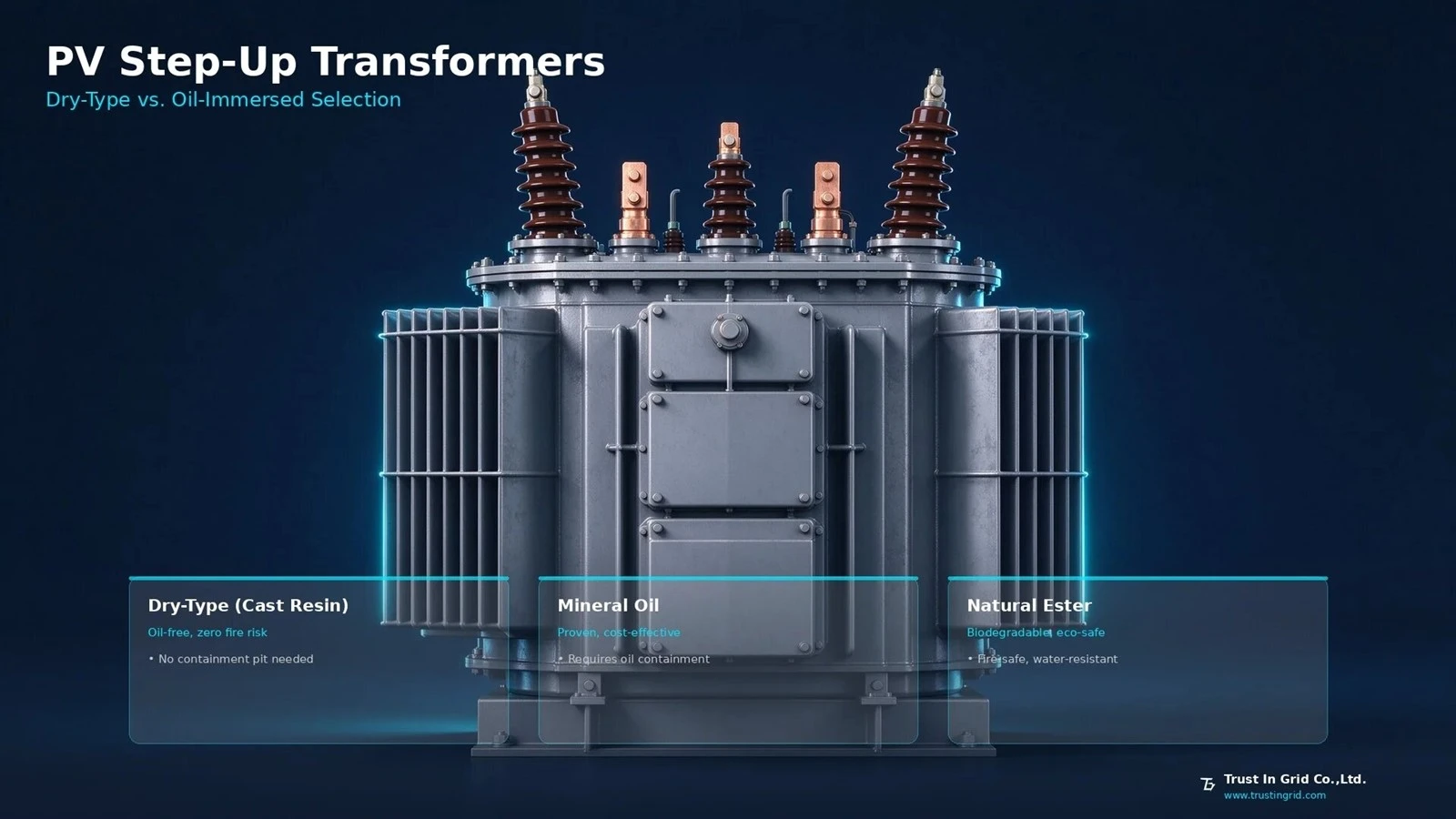
This is not a generic piece about why PV transformers matter. It is a look at the parameters that actually move the needle, and where dry-type, mineral oil, or natural ester makes sense.
(Insert Image 1: PV Step-Up Transformers - Dry-Type vs. Oil-Immersed)
1. Location Defines The Design
The electrical chain in a utility-scale plant is straightforward: PV strings → inverters (LV AC) → step-up transformer (MV) → collector lines → main substation → grid.
The step-up transformer sits right next to the inverter, often sharing a skid. It boosts the inverter's low-voltage output to the plant's internal collection voltage-typically 0.69/33kV or 0.8/13.8kV. In China, 0.4kV or 0.69kV up to 10kV or 35kV is more common.
This location means two things. First, if it's energized, no-load losses are happening, even at night when the inverters are dead. Second, PV output follows the sun. The transformer spends most of its life at low load, with a short, sharp peak at noon. It has to be designed for this curve, not treated like a continuous-duty distribution transformer.
2. Parameter Comparison: Dry-Type Vs. Mineral Oil Vs. Natural Ester
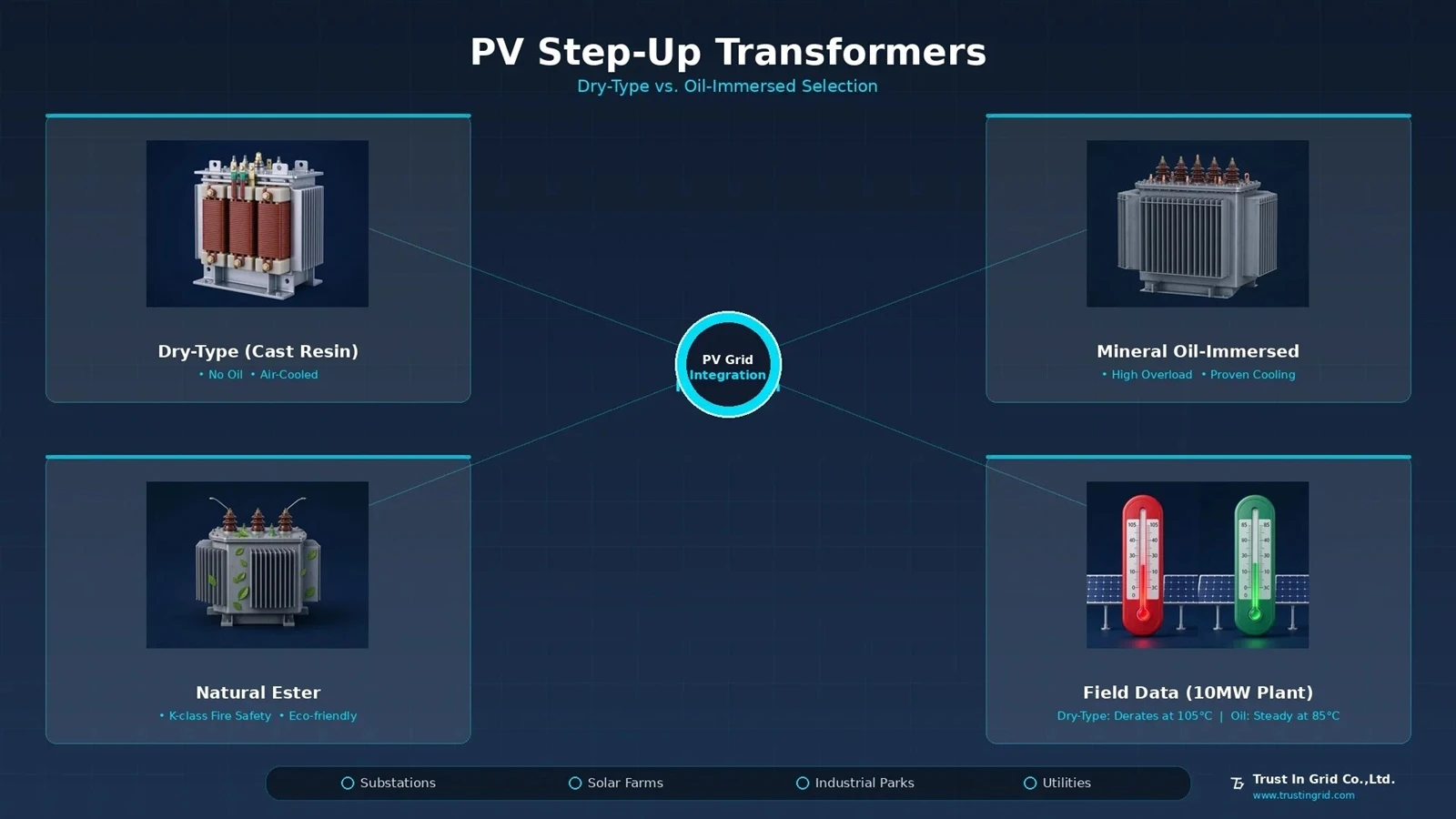
The core trade-off is cost, cooling, fire safety, and maintenance. Here is how the three options typically stack up in a PV setting.
| Parameter | Dry-Type (Cast Resin) | Oil-Immersed (Mineral) | Oil-Immersed (Natural Ester) |
|---|---|---|---|
| Typical Capacity | ≤2500–3150 kVA | Full range | Full range |
| Overload Capability | Moderate, derates in high heat | Strong, 1.3–1.5x short-term | Strong, higher thermal class |
| Fire Safety | No oil, inherently safe | Oil risk, needs fire walls/pits | K-class less-flammable fluid |
| Cooling Efficiency | Air-cooled, lower efficiency | Oil circulation, high efficiency | Oil circulation, high efficiency |
| Initial Cost | Higher (1.2–1.5x oil) | Low | 2.5x–5x mineral oil |
| O&M Cost | Low, no oil testing | Regular oil testing | Regular oil testing |
| Environmental Risk | No leak risk | Soil/water contamination risk | Readily biodegradable |
| Cold Climate | Good | Good | Pour point varies, needs selection |
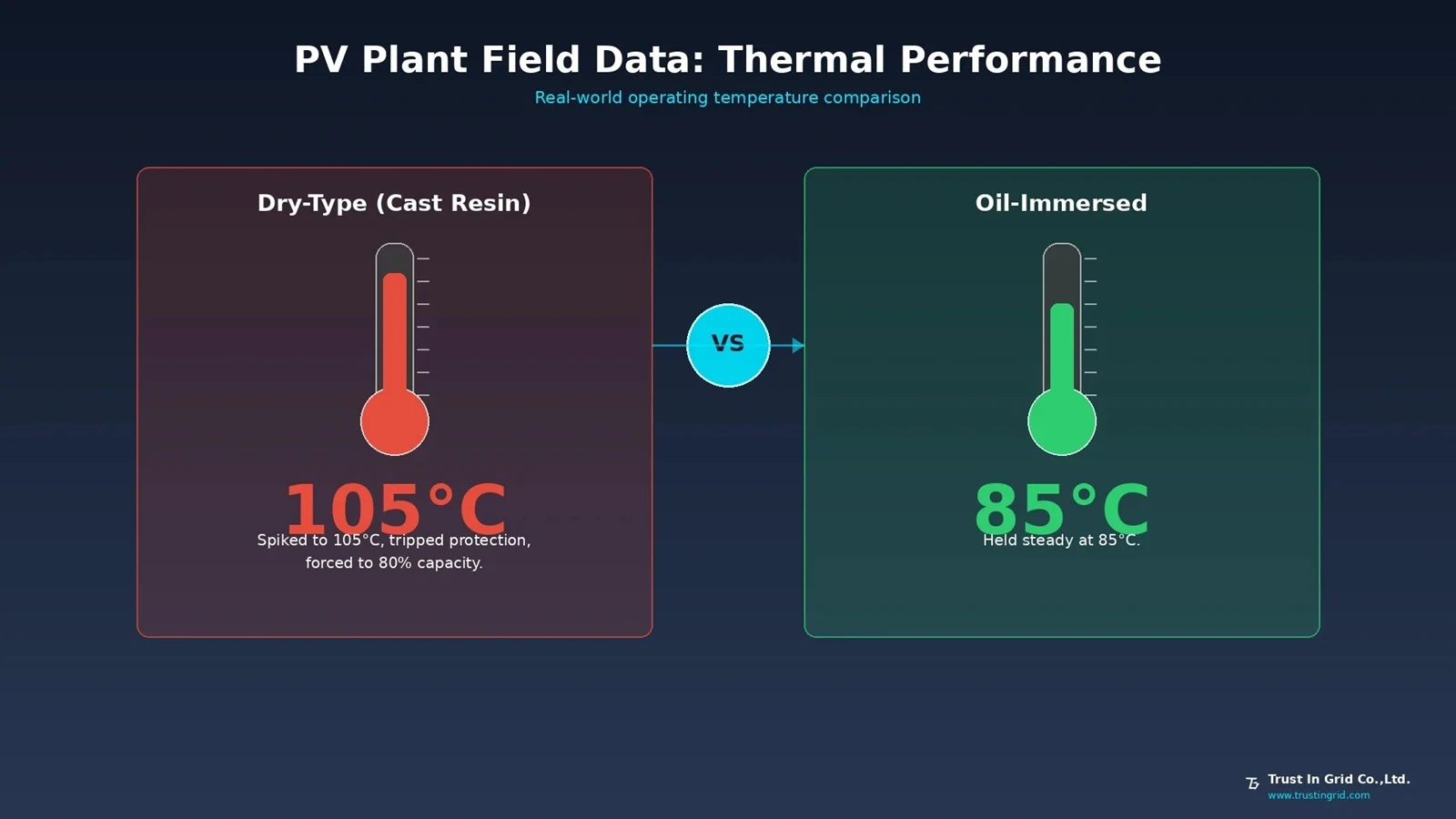
The dry-type weakness gets magnified on a solar farm. When PV output peaks at noon in summer, a dry-type unit with marginal cooling design can hit its temperature limit and derate. Field data from a 10MW plant with 20% DC/AC overbuild showed the oil-immersed unit holding steady at 85°C, while the dry-type spiked to 105°C, tripped protection, and was forced to 80% capacity. For a plant chasing yield, that's a real loss.
(Insert Image 2: PV Plant Field Data - Thermal Performance)
Mineral oil remains the default for large ground-mount projects. Cost, cooling, and overload capacity are proven. But fire codes and leak risk become constraints at certain sites.
Natural ester has an underrated edge here: thermal class. Under IEC 60076-14, a 105°C insulation system with mineral oil can be upgraded to a 120°C system with natural ester. That means the same transformer can handle the noon peak with less risk to insulation life, or be designed more compactly for the same load. Since the PV peak only lasts a few hours a day, this matches the duty cycle well. Yes, it costs more per liter, but if it lets you size down the unit or avoid derating, the real cost gap narrows.
3. Sizing: Do Not Just Match The Inverter
A common mistake is reading 500kW on the inverter nameplate and ordering a 500kVA transformer.
Inverter output isn't constant. DC/AC overbuild is standard practice-1.2 or 1.3 is common. The AC output can exceed the nameplate briefly. The transformer needs to cover that sustained peak, but sizing it too large just to cover a transient spike wastes no-load losses for the rest of the year.
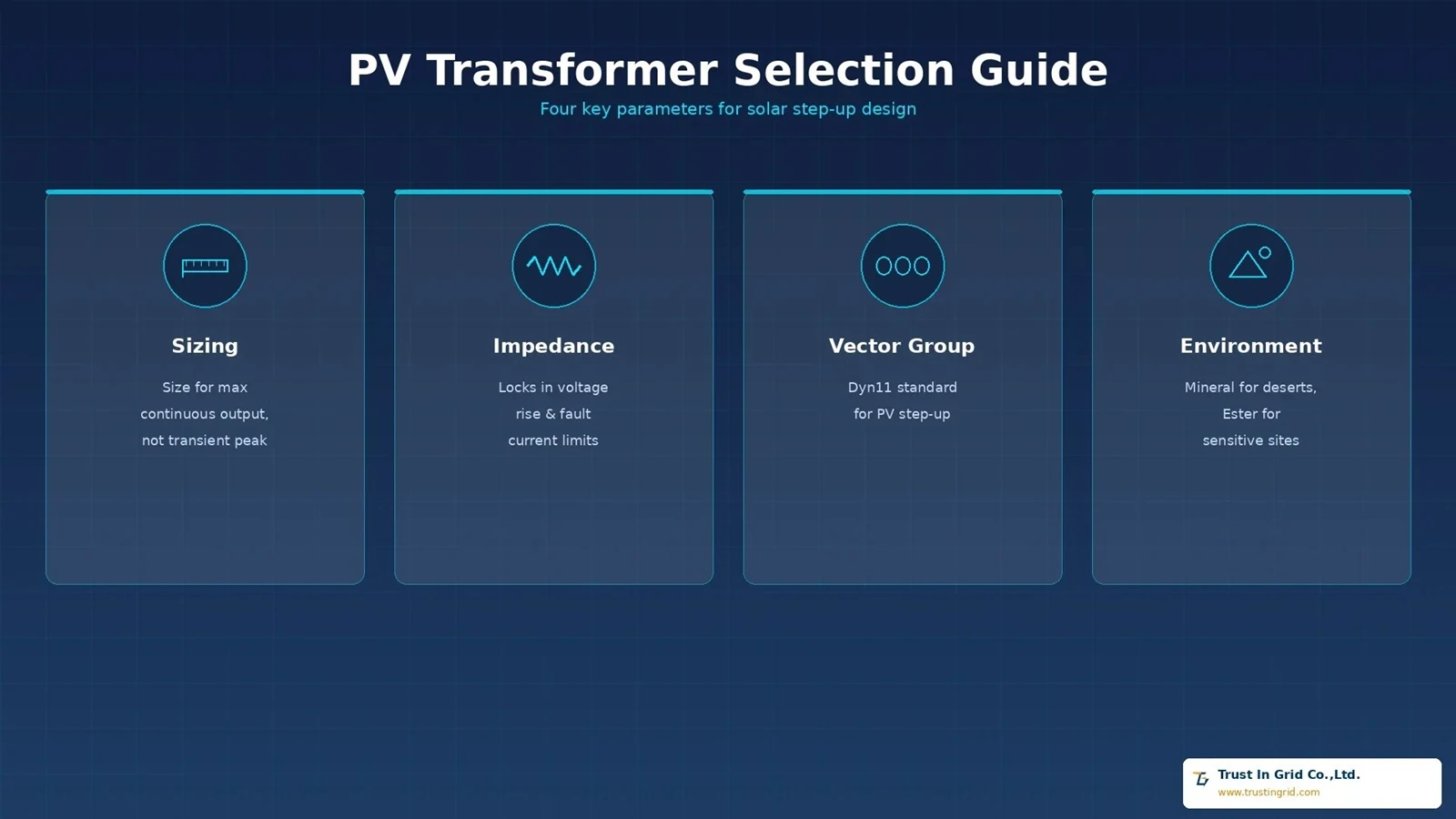
The rule of thumb: size the step-up transformer for the maximum continuous output of the PV block. Not the instantaneous peak. For overbuilt arrays, confirm the inverter's maximum continuous AC output with the manufacturer.
Impedance is the other critical number. It affects voltage rise and fault current. Too high, and you get excessive voltage drop at noon, pushing the point of interconnection voltage low. Too low, and fault currents spike, driving up switchgear requirements. This has to be locked in during the electrical design phase, not after the transformer is ordered.
(Insert Image 3: PV Transformer Selection Guide)
4. Vector Group And Voltage Regulation
Dyn11 is the standard vector group for PV step-up transformers. The delta winding suppresses third harmonics. The grounded wye provides a neutral for earth fault protection. The 11 o'clock connection gives the required phase shift for parallel operation.
For voltage regulation, on-load tap changers (OLTC) are usually overkill for the local step-up unit. There is no frequent need to adjust voltage inside the plant, and an OLTC just adds cost and a failure point. Off-circuit tap changers (NLTC) do the job. The main substation transformer might need an OLTC if grid voltage fluctuates heavily or there are dynamic power factor requirements.
One easily missed detail: inverter harmonics. The transformer needs to be designed for inverter duty. If multiple central inverters without high-frequency circulating current suppression are tied to the same transformer, a split-winding transformer with a split factor of at least 3 should be used to prevent circulating currents between inverters.
5. What Fits Where
Large ground-mount (desert, gobi, mining subsidence areas): Mineral oil-immersed is the default. Low cost, great cooling, strong overload capacity, handles big temperature swings. Just make sure the enclosure is rated for wind-blown sand and the sealing is solid.
Mountainous, agrivoltaic, or ecologically sensitive sites: Natural ester deserves a hard look. Biodegradability reduces the risk of soil and crop contamination if a tank leaks. K-class fire rating cuts fire infrastructure costs. If the project has ESG scoring, the carbon footprint data is a plus.
Rooftop and industrial parks: Dry-type or small oil-immersed. Roof load limits and strict fire codes favor the no-oil approach. But watch the summer derating risk; don't cheap out on the cooling design.
Cold climates (high latitude, high altitude): Natural ester requires screening for low-pour-point grades. Standard esters struggle below -20°C, though low-temp formulations reach -66°C. Mineral oil has no such issue.
(Insert Image 4: PV Step-Up Transformers Radial Summary)
We build transformers and supply core materials. If you are evaluating PV step-up transformers-capacity, type, loss targets, or core design-send us the specs. Grid voltage, inverter capacity, overbuild ratio, site conditions, timeline. You will get a straight answer.
TIG - Trust in Grid
www.trustingrid.com
asia@trustingrid.com
References
[1] Grid-Connected Solar PV Power Plants Optimization: A Review, IEEE Xplore, 2023.
[2] Load Characteristics of PV Power Plants and Transformer Type Selection, China Industry Information Network (Jijing), 2022.
[3] Solar Step-up Transformer: Inverter LV to MV Grid Connection, Heaven Designs, 2026.
[4] Dry-Type vs. Oil-Immersed Transformers for PV Step-Up Stations: Application Scenarios and Pros/Cons, Cnboda, 2025.
[5] PV Grid Connection and Transformer Specification Selection, ceegenergy.com, 2024.
[6] GB 50797-2012 (2024 Edition) Design Standard for Photovoltaic Power Stations, Section 8.1 Transformers.
[7] A probabilistic approach to size step-up transformers for grid connected PV plants, ScienceDirect, 2012.