


Wind Farm Transformer Requirements: Onshore vs. Offshore Applications
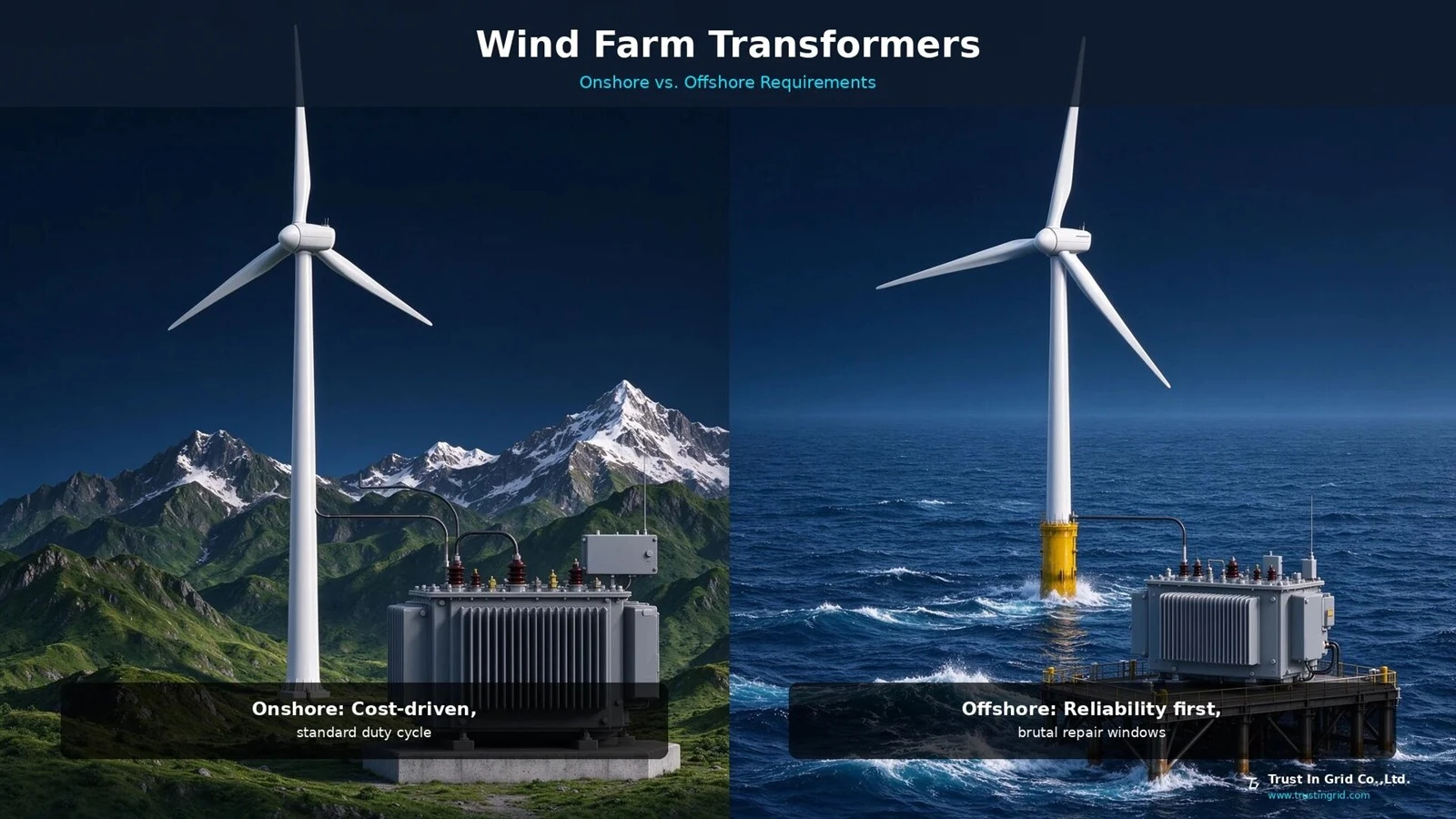
Wind farm transformers-onshore and offshore-are two different animals. Onshore projects can follow standard power engineering logic: calculate losses, size the unit, pick a cooling method. You have space, roads, and a repair window. Offshore is different. If a transformer fails out there, you wait months for a repair vessel. Downtime is measured in lost generation. You aren't just asking "will it work." You are asking "what happens when it breaks."
Here is where the engineering requirements actually diverge.
1. Onshore: Standard Equipment, Punishing Duty Cycles
Onshore wind uses two types of transformers. The turbine step-up transformer sits in the tower or on the pad, boosting the generator's LV output to the collector voltage (usually 35kV). The main substation transformer takes those collector lines and steps them up for the grid.
Turbine step-up transformers are tight on space. The tower diameter limits the footprint, so the unit has to be compact. Dry-type transformers are common inside the tower-no oil, easier fire compliance, low maintenance. But watch the derating risk. When summer hits and the wind blows hard, a dry-type unit with marginal cooling hits its temperature limit and trips. That's lost generation.
Oil-immersed units on the pad are the other option. Lower cost, better overload capacity, handles fluctuating wind well. Natural ester has a practical angle here: the K-class fire rating cuts fire protection requirements near the tower and nacelle. The biodegradability helps with permits in mountainous, forested, or water-adjacent sites.
One thing often missed onshore: cold. High-latitude or high-altitude wind farms see -30°C. Standard natural esters gel up. You have to screen for low-pour-point grades. Mineral oil handles the cold, but you still need to check viscosity rise and its effect on cooling.
IEC/IEEE 60076-16 is the specific standard for wind turbine transformers, covering both dry and liquid-immersed up to 72.5kV. The 2018 revision tightened the testing requirements, making sure the unit can survive the brutal electrical environment of a wind turbine. Confirming the factory tested to this standard is more relevant than just citing generic IEC 60076.
2. Offshore: Reliability Eats Cost for Breakfast
Offshore layout dictates the design.
Turbine/Nacelle Transformers: Inside the turbine, typically 6-10 MVA, 66kV and below. Space is a joke, cooling is tough, salt spray is constant. Vibration isn't an event; it's the baseline. Dry-type or specially designed liquid-immersed units work here, but the core requirement isn't efficiency. It's "don't break."
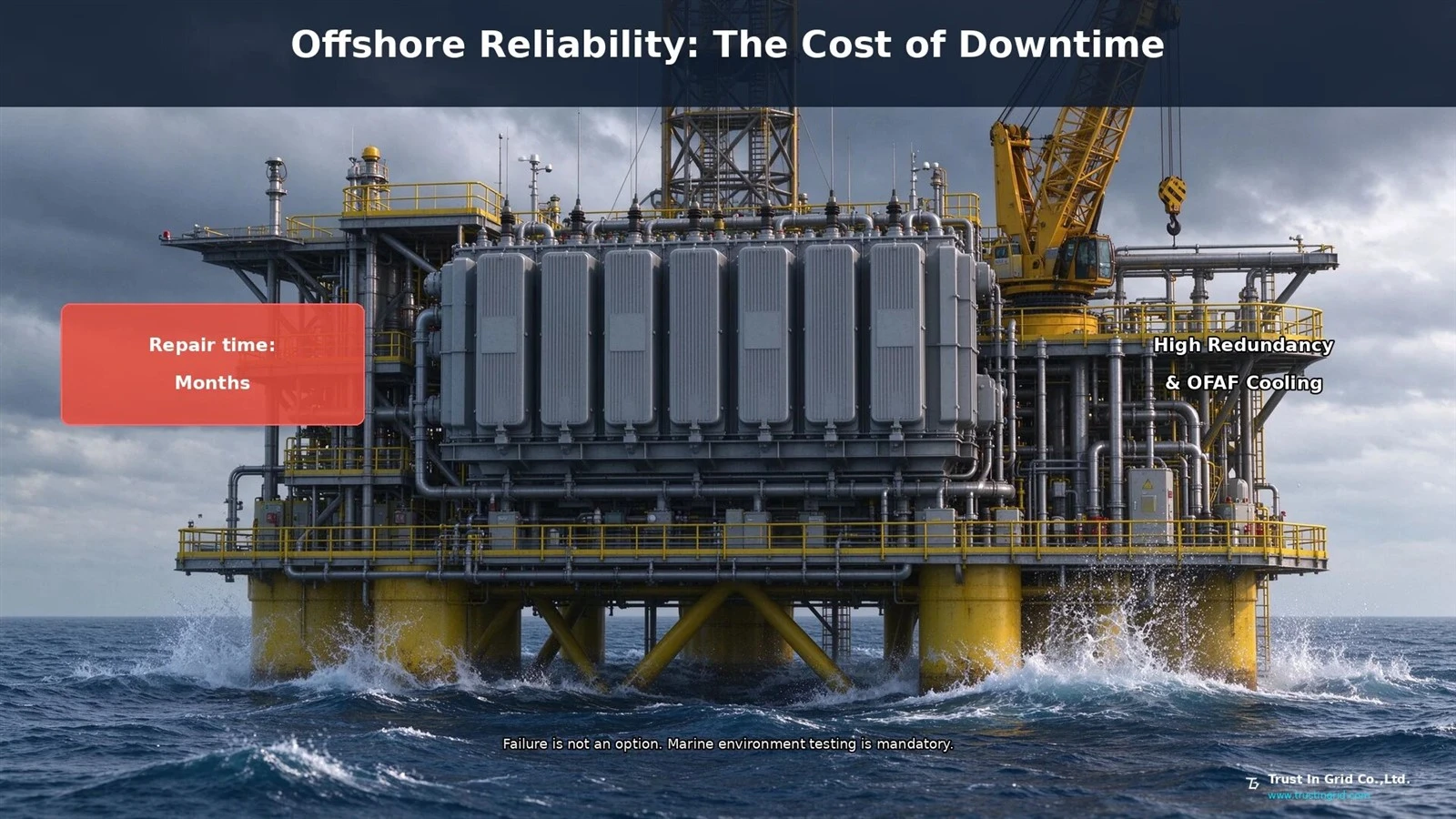
Offshore Substation Main Transformers: These step up collector voltage to export voltage (220kV or 330kV). They are the throat of the wind farm. One main transformer failure can cut the site's export capacity in half or to zero. Offshore repairs are brutal: vessels, weather windows, spare parts. Any delay costs real money. Industry estimates put offshore transformer repair time in months, with costs vastly exceeding onshore.
So offshore main transformers are built with redundancy. Forced oil cooling (OFAF or ODAF) is standard to ensure zero derating during peak summer output. The tank and externals must be specified for marine environments; salt spray testing is baseline. Transport and installation actually drive the design backwards: platform space and crane capacity are limited. The transformer has to be compact, or shipped disassembled and built on-site-both add engineering and manufacturing cost.
Natural ester is gaining traction offshore, but for different reasons than onshore. Changing oil offshore is practically impossible. A mineral oil leak into the ocean is a legal and PR nightmare. Biodegradability becomes a hard compliance advantage. The K-class fire rating also simplifies fire suppression on a confined offshore platform.
3. Parameter Comparison: Onshore vs. Offshore
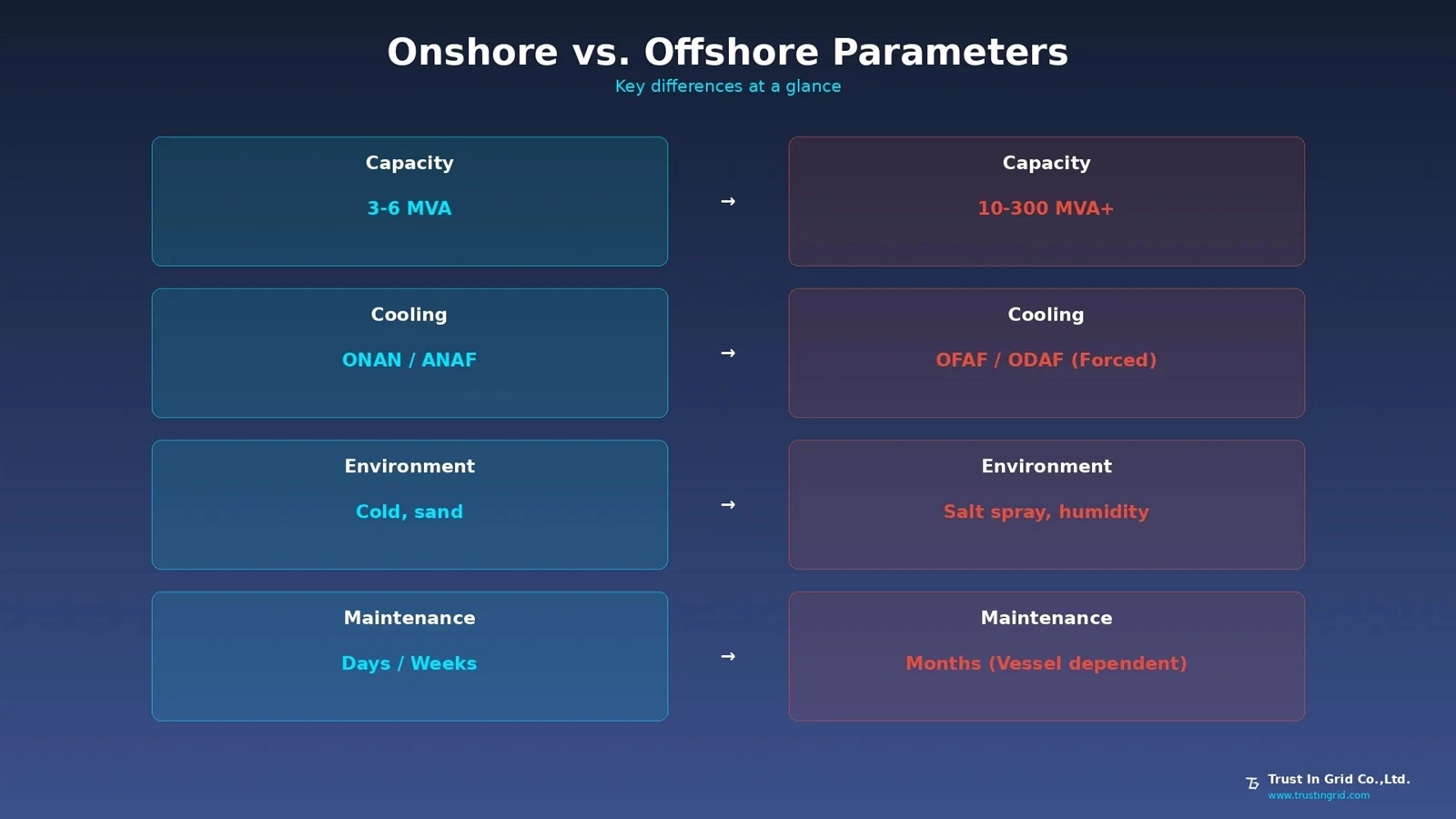
| Parameter | Onshore Wind | Offshore Wind |
|---|---|---|
| Turbine Step-Up Capacity | 3–6 MVA | 6–10 MVA (Tower/Nacelle) |
| Main Transformer Capacity | 50–240 MVA (Substation) | 100–300 MVA+ (Offshore Substation) |
| Voltage (Turbine Side) | 35kV typical | 66kV and below |
| Voltage (Export) | 110–330kV | 220–500kV |
| Cooling | Mostly ONAN/ANAF | Mostly OFAF/ODAF, forced |
| Fire Safety | Standard, dry/oil both work | Strict, confined space, ester favored |
| Environment | Cold, sand, altitude | Salt spray, humidity, vibration, space |
| Maintenance Access | Road access, days/weeks | Vessel dependent, months |
| Fault Tolerance | Replace or bypass | Extremely low, high design redundancy |
| Natural Ester Fit | Eco-sensitive sites, fire-risk locations | High, driven by compliance and fire safety |
| Cost Sensitivity | High | Lower, reliability premium accepted |
The offshore market numbers back this up. The global offshore wind transformer market hit roughly $3.4–3.6 billion in 2025, projected to reach $8.4–8.6 billion by 2032, growing at about 12% CAGR. The trend is bigger turbines and deeper water, pushing reliability and environmental requirements even higher.
4. Standards: Do Not Use Onshore Rules Offshore
IEC/IEEE 60076-16 covers wind turbine transformers up to 72.5kV. It applies to the turbine step-up, not the main substation transformer. Offshore main transformers use the general IEC 60076 series but must add marine environmental testing: salt spray, damp heat, vibration, and inclination.
When writing the spec, don't just cite the general standard. Add separate clauses for corrosion protection, vibration, and inclination. That's where offshore units fail. If the manufacturer has a track record offshore, ask for third-party test reports, especially for salt spray and vibration.
Onshore, IEC/IEEE 60076-16 is enough. But for cold sites, add a clause for low-temperature startup and loading, plus the low-temperature fluidity of the oil if liquid-immersed.
5. What Fits Where
Standard onshore (North China, mountainous East): Dry-type or mineral oil for the turbine step-up, built to IEC/IEEE 60076-16. Cost first, but leave cooling margin. Main substation transformers are standard power transformers; watch losses and impedance.
Eco-sensitive or high fire-risk onshore: Look at natural ester. The K-class rating and biodegradability smooth out permits and insurance. Screen for low-pour-point if it gets cold.
Offshore turbine/nacelle: Compact, anti-corrosion, vibration-resistant. Dry-type and special liquid-immersed both exist. Confirm marine testing data. Natural ester wins on fire safety in enclosed spaces and leak environmental risk.
Offshore main substation: Reliability first. Forced cooling, high corrosion protection, and transport/installation plans locked in at the design stage. Natural ester's environmental compliance is a huge plus here, but confirm the manufacturer has the voltage and MVA track record.
We build transformers and supply core materials. If you are evaluating transformers for a wind project-capacity, type, loss targets, core grade, or corrosion specs-send us the details. Voltage, location (onshore/offshore), environment, volume, timeline. You will get a straight answer.
TIG - Trust in Grid
www.trustingrid.com
asia@trustingrid.com
References
[1] IEC/IEEE 60076-16:2018, Power transformers – Part 16: Transformers for wind turbine applications, IEC/IEEE, 2018.
[2] Offshore Wind Power Transformer Market Report 2026, QYResearch, 2026.
[3] Offshore Wind Power Transformer Market Report 2026, LP Information, 2026.
[4] Offshore Transmission Network Security Recommendations, Ofgem, 2008.