


Microgrid Transformers: Design Challenges and Sizing Considerations
Sizing a transformer for a microgrid is fundamentally different from a standard distribution transformer. On a normal grid, the load is relatively predictable. On a microgrid, the load is a guess.
An islanded microgrid might serve a village's residential load today, and tomorrow it might have to swallow a massive reverse power flow from solar because the battery dispatch strategy changed. In grid-connected mode, the main grid holds the voltage and frequency; the transformer is just a power channel. At the moment of islanding, that transformer has to help anchor the voltage and frequency of the entire microgrid. If you just take the max load, divide by 0.8, and call it a day, you are going to get burned.
Here is what actually matters during the design phase, and how to size the unit without wasting money.
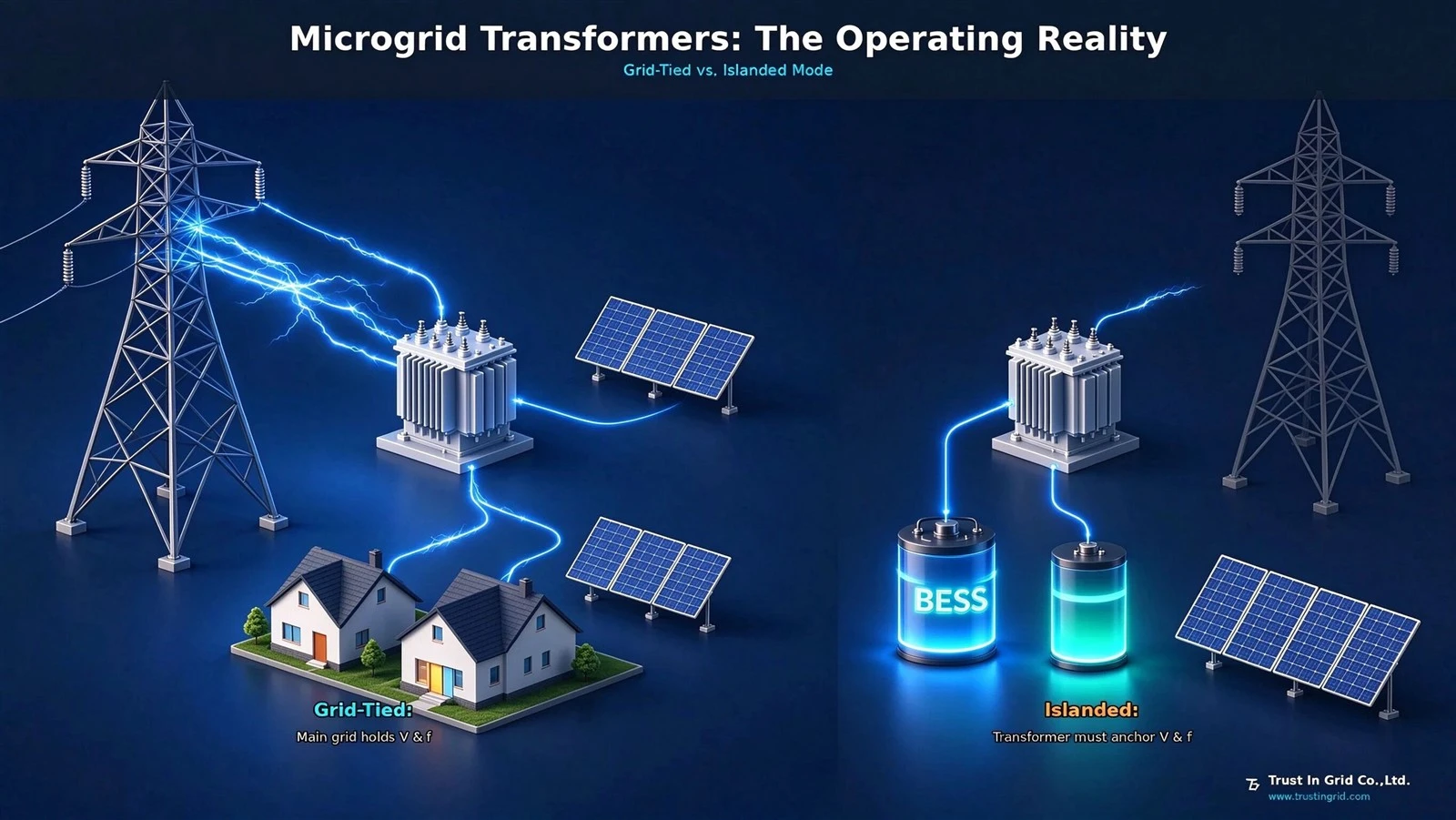
1. The Operating Realities of Microgrid Transformers
Standard distribution transformers assume a relatively smooth load curve and steady-state thermal conditions. Microgrid transformers face constant mode switching.
In grid-tied mode, the main grid provides the voltage and frequency reference. The transformer just passes power. In islanded mode, the transformer might have to work with battery energy storage systems (BESS) and PV inverters to become a voltage and frequency reference for the microgrid.
During the transition, power flow reverses, voltage transients hit, and harmonics get injected-all at the same time. If the transformer is only designed for grid-tied conditions, it might overheat or trip protection when the microgrid goes island.
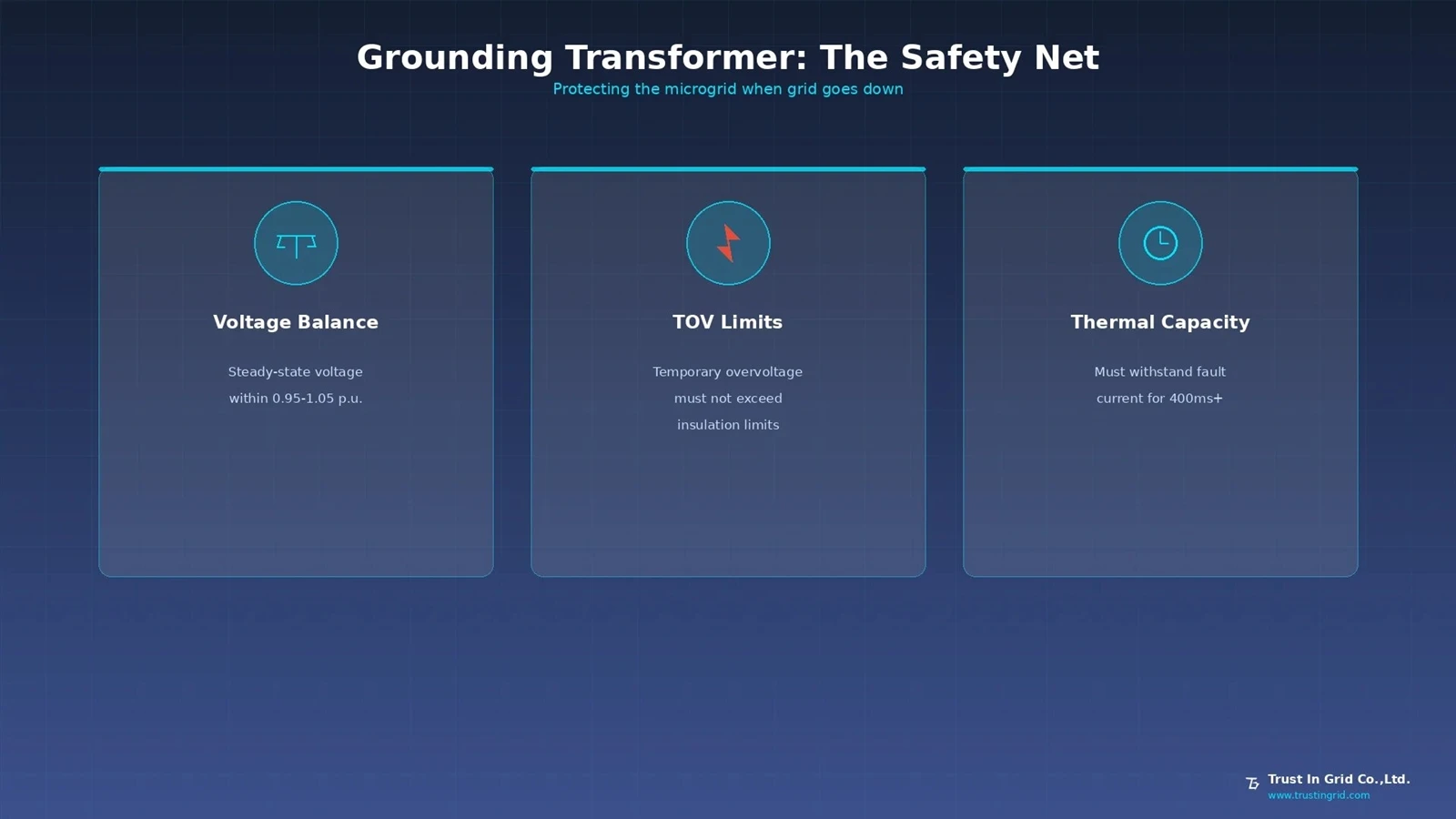
Another thing people miss: grounding. When a microgrid islands, the neutral grounding provided by the main grid disappears. If you don't add a grounding transformer, a single-phase-to-ground fault has no return path. The protection system won't see the fault current, and the overvoltage can punch through insulation. The capacity and impedance design of that grounding transformer directly affect personnel safety and equipment insulation in islanded mode.
2. Sizing: Do Not Just Look at Peak Load
The biggest mistake in microgrid transformer sizing is taking the peak load, dividing by 0.65 or 0.8, and adding a safety margin. That logic works for standard distribution grids, but it falls apart in microgrids.
Why? Because power flow is not unidirectional. The PV peak and the load peak might not align. Battery charging and discharging add another layer of complexity. The transformer's actual load factor might swing from near-zero to near-rated, and back to zero in a single day. Under cyclic duty, insulation thermal aging doesn't accumulate based on average load-it accumulates based on peak temperature and cycle counts.
If you look at real-world data from PV and EV-heavy neighborhoods, the transformer's overload cycles jump significantly. If EV charging is unmanaged, the transformer might overload during the evening peak. If an energy management system shifts the charging, the overload can be mitigated. Microgrid sizing requires stacking the source, load, and storage time-series curves together, not just looking at one peak number.
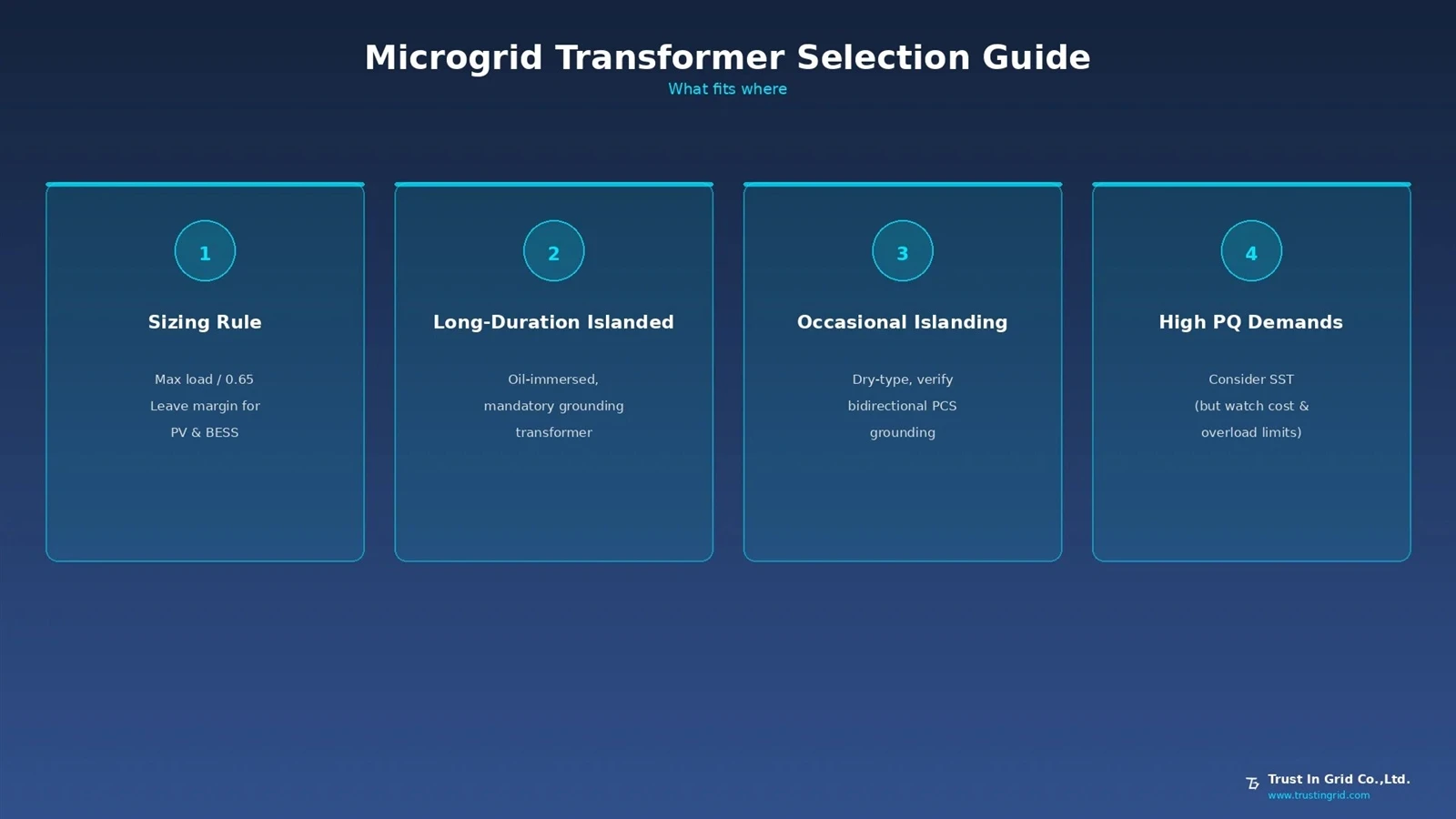
A practical engineering rule of thumb: for microgrids requiring long-term power supply, size the transformer by dividing the max load by 0.65. That's not a random number. It leaves buffer for PV fluctuations, BESS charge/discharge transitions, and future load growth. Size it too tight, and the transformer becomes a bottleneck when the BESS discharges and solar output peaks at the same time in islanded mode.
3. Grounding Transformers: The Safety Net for Islanded Mode
The core conflict in microgrid grounding design: you can't interfere with the main grid's grounding system when tied, but you must establish your own grounding reference when islanded.
The traditional fix is a dedicated grounding transformer. But they are big, expensive, and if you have multiple sub-microgrids, you might need one for each-terrible for the budget. Another approach is using the distributed energy resource (DER) transformer itself for grounding by switching winding connections-disconnecting the neutral when tied, and connecting it when islanded. But if designed poorly, this can mess with the main grid's zero-sequence current distribution during grid-tied operation.
Grounding transformer impedance design has to meet two conditions simultaneously: in steady-state, the neutral voltage shift must keep the single-phase voltage within 0.95–1.05 p.u.; during a single-phase ground fault, the temporary overvoltage (TOV) on the healthy phases must not exceed equipment insulation limits. These two conditions often pull the impedance in opposite directions-too low, and you get steady-state voltage imbalance; too high, and the TOV during a fault gets out of hand. You need an impedance sweep and find the intersection of the two boundaries.
Thermal capacity is another critical sizing parameter. The fault current duration depends on the protection clearing time. If protection is set to 400ms, the grounding transformer's thermal withstand time cannot be less than that. If you only look at continuous capacity and ignore thermal capacity, the grounding transformer will cook during a fault.
4. Should You Use Solid-State Transformers (SST)?
The big topic everyone asks about is SST. Replacing the iron core with power electronics theoretically gives you a smaller footprint, more functions, and faster response. But the reality is that SSTs in microgrids are currently a niche supplement, not a wholesale replacement for conventional transformers.
The advantage of SST is controllability. It can actively regulate voltage, isolate harmonics, limit fault currents, and even provide both AC and DC ports simultaneously. For multi-energy microgrids, that's attractive. But the downsides are obvious. SSTs don't pack the short-term overload punch of a traditional transformer. The thermal capacity of power electronics is limited. When microgrid power fluctuates, the SST's regulation margin is small, which can affect system stability. Plus, the cost is way higher than a conventional transformer of the same rating. For most microgrid projects, the economics just don't work yet.
So here is the straight answer: if you absolutely need multi-port access or fast response for power quality, look at SST. Otherwise, stick to a standard transformer with a smart terminal. It's cheaper and handles surges better.
5. What Fits Where
Long-duration islanded microgrids (remote areas, islands): A grounding transformer is mandatory. Size it based on the max single-phase fault current and protection clearing time. Go with oil-immersed for the main transformer-better overload capacity. For sizing, start with max load divided by 0.65.
Grid-tied mostly, occasional islanding (parks, industrial): Dry-type is better for indoor installation and fire safety. If islanding happens frequently, confirm the transformer can handle the constant power direction flips. You can try using the BESS PCS transformer for grounding, but you must verify it doesn't mess with the main grid when tied.
Multi-source, multi-sub-microgrids: Grounding design gets complicated. Every sub-microgrid needs a grounding reference when operating independently, but putting a dedicated grounding transformer in each one is too expensive. The controllable DER transformer grounding scheme is worth looking at. The key is switching the grounding state between grid-tied and islanded modes.
High power quality demands (data centers, precision manufacturing): Put SST or hybrid transformers (traditional core + power electronics) on the evaluation list. But calculate the SST's overload limits and cost premium into the full life-cycle cost. Don't just look at the feature list.
We build transformers and supply core materials. If you are evaluating transformer specs for a microgrid project-grounding requirements, islanded-mode overload capacity, cyclic rating, or core grade-send us the details. Operating modes, source mix, load profile, voltage level, timeline. You will get a straight answer.
TIG - Trust in Grid
www.trustingrid.com
asia@trustingrid.com
References
[1] A Controllable Distributed Energy Resource Transformer-Based Grounding Scheme for Microgrids, IEEE Open Access Journal of Power and Energy, 2024.
[2] Transformer operating conditions under introduction of PV and EVs in an eco-district, IEEE PES General Meeting, 2015.
[3] Optimization of High-Frequency Isolation Topology for Solid-State Transformers in PV Microgrids, Inner Mongolia Power (Group) Co., Ltd. Baotou Power Supply Bureau.
[4] Research on Optimal Dispatch of Microgrids with PET, Power Automation Equipment, 2020.
[5] Grounding impedance and thermal current design for microgrid grounding transformers, University of Tennessee Dissertation.
[6] IEEE Std C57.12.00-2015, Standard for General Requirements for Liquid-Immersed Distribution, Power, and Regulating Transformers.