


Predictive Maintenance for Power Transformers: How AI Reduces Downtime
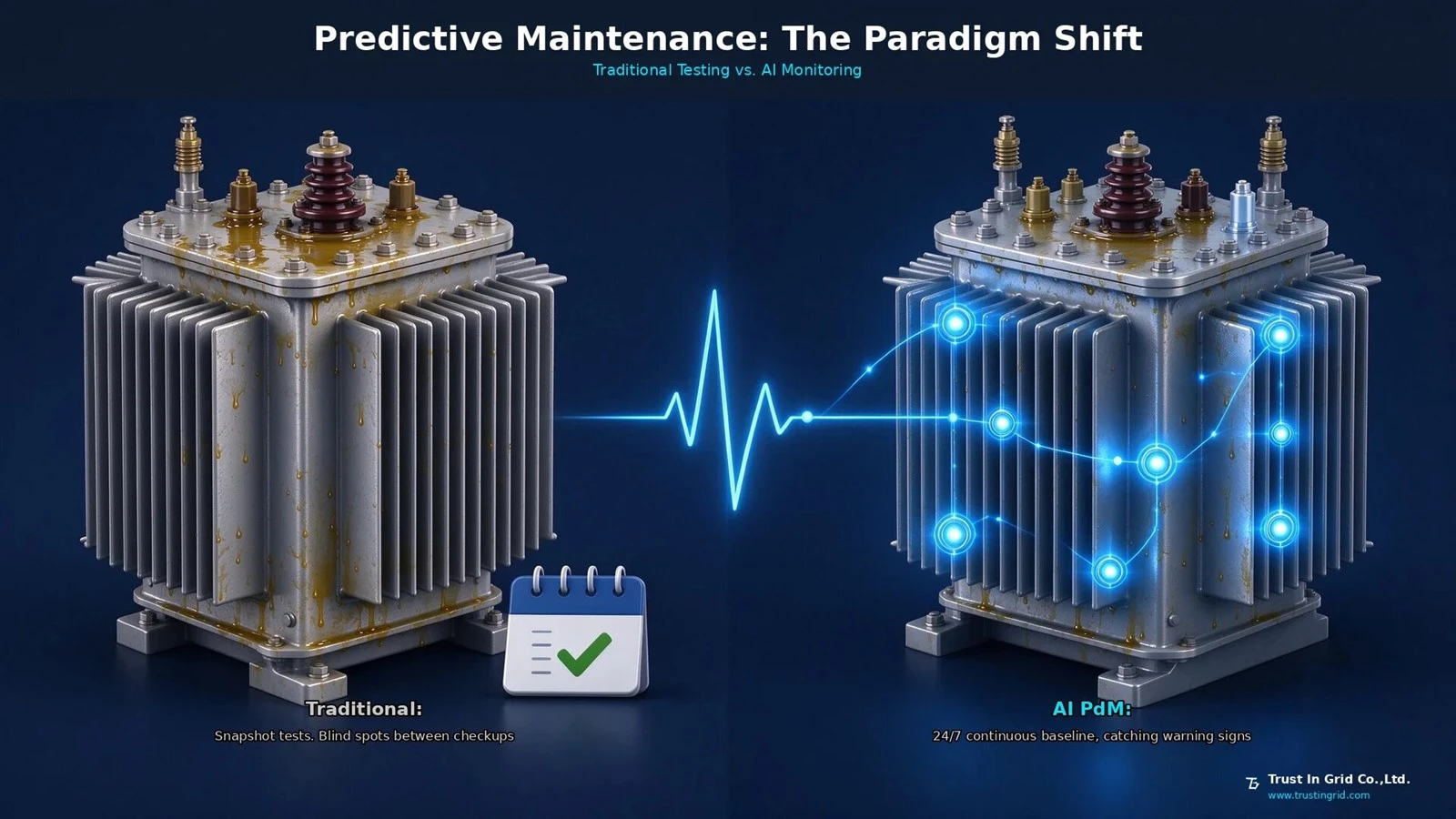
Transformers don't just blow up out of nowhere. Before a catastrophic failure, there is usually months of warning. Dissolved gas analysis (DGA) levels creep up, partial discharge activity quietly spikes, and hot-spot temperatures start acting weird. The problem is traditional preventive maintenance is usually a once-a-year (or once-every-few-years) thing. That's like giving a patient a checkup every six months and hoping you don't miss a heart attack in between.
Predictive maintenance (PdM) flips the logic: use real-time sensor data instead of scheduled offline tests, and use algorithms to predict when the asset will fail, so you can schedule the repair before the lights go out. AI's role here isn't replacing the engineer; it's helping them dig through mountains of noisy data to find the one trend that actually matters.
This article skips the sci-fi concepts. It's a field-level look at what AI PdM actually does, where it fails, and how to calculate the ROI.
1. Why Traditional Monitoring Isn't Enough
Substations aren't exactly starved for data. Many transformers already have online DGA, fiber-optic temperature sensing, and partial discharge (PD) sensors. But most of that data just sits in isolated software silos.
Traditional software logic is "threshold alarming." If acetylene hits 5 μL/L, send an SMS. The fatal flaw? The false positive rate is through the roof. The transformer load spikes, oil temp shoots up, and gas slightly increases. Or the sensor probe ages and drifts, spitting out weird numbers. The O&M crew gets ten alerts, rushes to the site, and finds nine are false alarms. After a few trips, the system becomes the boy who cried wolf. Nobody looks at it anymore.
AI's first job is killing those false positives. Instead of staring at one metric crossing a red line, AI looks at the spatiotemporal correlation of multi-source data. If oil temp is rising, but load rate is also climbing and DGA is stable, AI knows it's just normal overload heating. But if load hasn't changed, acetylene slightly increased, and PD signals are getting active-AI bumps the alert to maximum.
2. What AI Actually Does in PdM
Don't let the vendor slides about "Deep Learning" and "Foundation Models" scare you. In transformer PdM, AI's actual job comes down to basic pattern recognition.
The first task is building a dynamic baseline. Every transformer is a bit different. AI learns its specific "healthy" operating envelope-how hot the oil should be at 80% load in July versus 50% load in January. When data drifts off that learned baseline, you get an alert, not just when it hits an arbitrary absolute number.
The second task is fault classification. A rising acetylene level means arcing, right? But what if it's accompanied by a massive spike in partial discharge and normal load? Traditional ratio methods might give you a vague answer. AI cross-references the DGA ratios, the PD patterns, and the temperature history, then tells you it's probably a localized winding fault, not just general overheating.
The real money-maker is Remaining Useful Life (RUL) estimation. By chewing through historical load curves and hot-spot data, the model estimates the degradation rate of the paper insulation (the Degree of Polymerization, or DP). This tells you if the transformer has five years left or fifteen. That completely changes how you plan your maintenance budget.
3. Three Traps in Field Deployment
Buying a fancy algorithm is easy. Keeping it alive in a substation is hard.
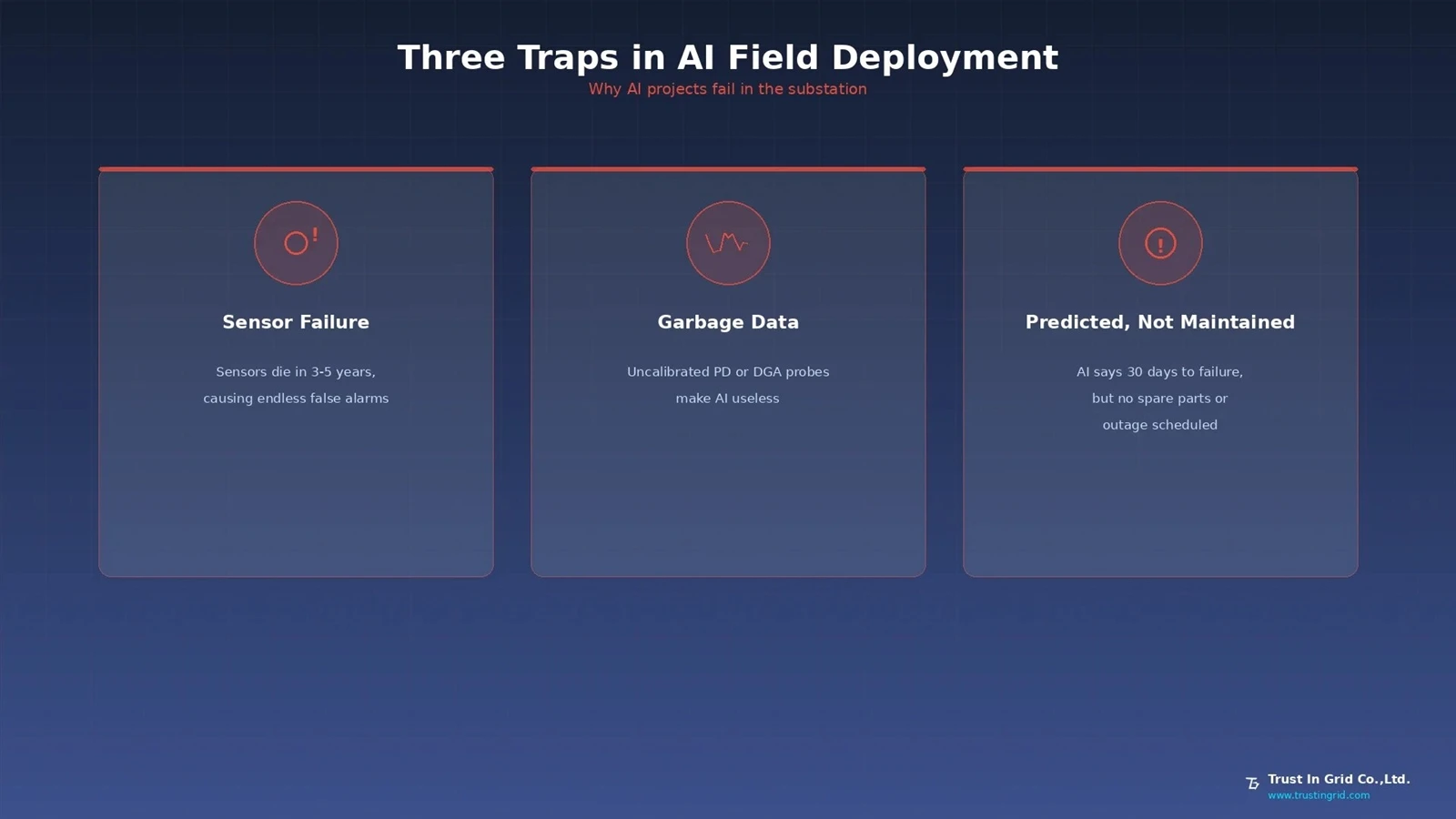
First, the sensor dies before the transformer does. A transformer is built for 30+ years. An online DGA probe or PD sensor sitting in the oil or strapped to the tank might drift or fail in three to five years. If the hardware starts spitting out garbage data and the AI keeps analyzing it, the system throws endless false alarms. The O&M team gets annoyed, stops trusting it, and eventually unplugs the terminal. Hardware reliability beats algorithm accuracy every time.
Second, the data is garbage to begin with. The golden rule of AI is "garbage in, garbage out." If the PD sensor is constantly picking up electromagnetic interference from nearby switchgear, or the DGA probe hasn't been calibrated in years, no algorithm on earth will predict accurately. Without reliable data acquisition hardware, AI is just decoration.
Third, the "predicted, but not maintained" problem. The AI system pops an alert: "Transformer A projected to hit critical risk in 30 days." The O&M guy reads it, then checks the schedule and realizes there's no planned outage next month, or the spare parts aren't in the warehouse. You predicted the failure, but you couldn't do anything about it. If the AI data doesn't talk to the Enterprise Asset Management (EAM) system or the maintenance scheduling team, it's just an expensive digital dashboard.
4. Where AI PdM Is Worth It
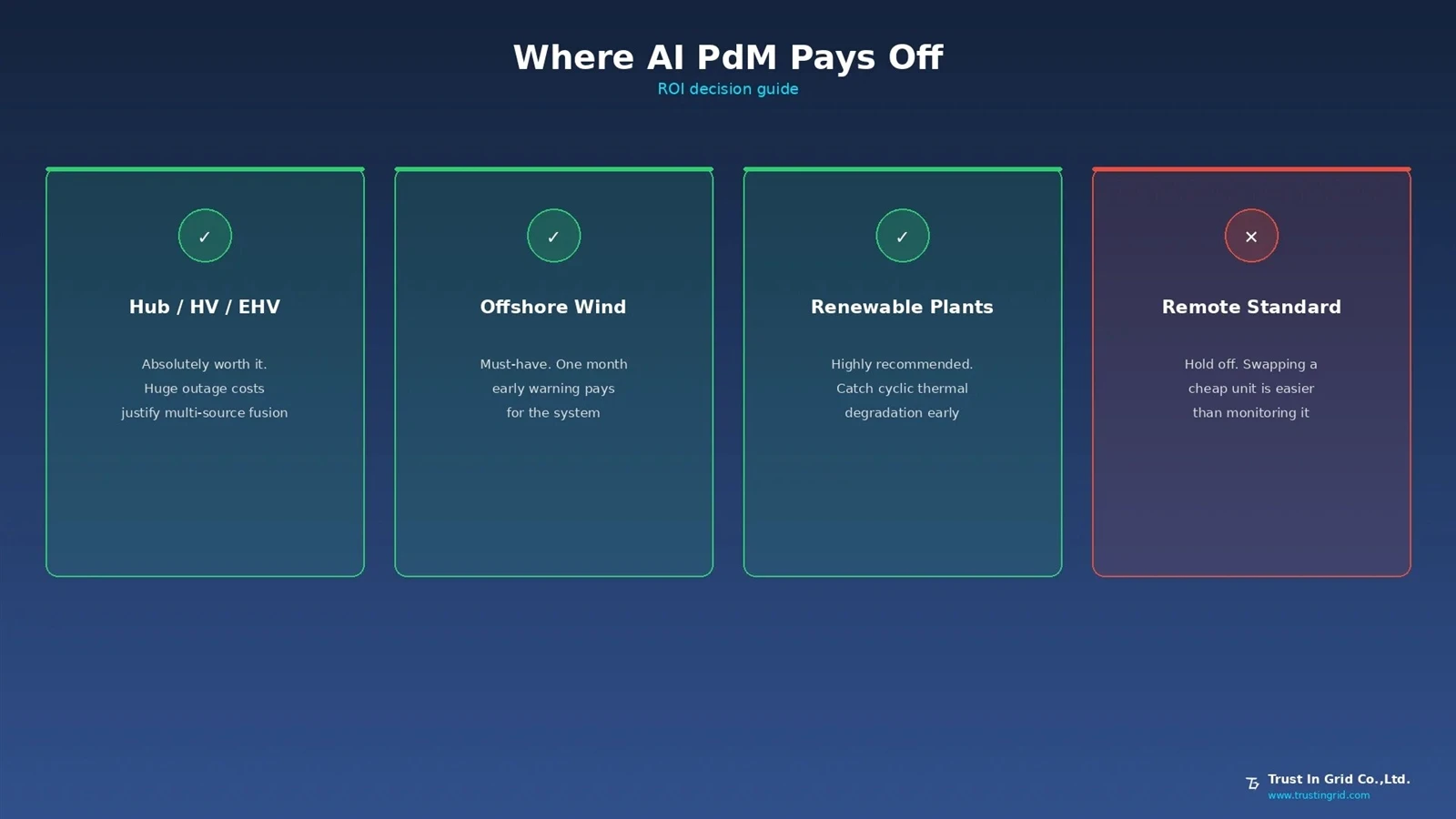
Hub substation main transformers, HV/EHV units: Absolutely worth it. An unplanned outage here impacts the whole grid, and the repair bill is astronomical. Multi-source fusion of DGA and PD giving months of early warning makes the ROI incredibly easy to justify.
Offshore wind step-up transformers: Must-have. The maintenance cost offshore (vessels, weather windows) is astronomical. Even if AI only gives you a one-month early warning, the saved downtime pays for the system several times over.
Renewable plant main transformers (PV/Wind): Highly recommended. These transformers eat massive power swings and cyclic thermal stress. Insulation degrades faster than on a standard grid. AI can combine renewable output forecasts to catch anomalies early.
Remote standard distribution transformers: Hold off. Low unit cost, difficult access, and sometimes no stable comms network. If a standard distribution unit breaks, swapping it out is often cheaper than installing a monitoring system.
We build transformers and supply core materials. If you are evaluating transformer designs or specifications for projects that prioritize reliability and data-driven maintenance-such as embedding sensors during manufacturing or selecting high-grade GOES for critical nodes-send us your details. Transformer type, voltage level, load profile, timeline. You will get a straight answer.
TIG - Trust in Grid
www.trustingrid.com
asia@trustingrid.com
References
[1] Artificial Intelligence for Predictive Maintenance of Power Transformers: A Review, IEEE Transactions on Power Delivery, 2023.
[2] Machine Learning-Based Condition Monitoring and Fault Diagnosis for Power Transformers: A Review, IEEE Access, 2022.
[3] Remaining Useful Life Estimation of Power Transformers Based on Multi-Source Data Fusion and Deep Learning, IEEE Transactions on Dielectrics and Electrical Insulation, 2024.
[4] Predictive Maintenance for Power Transformers Using Dissolved Gas Analysis and Environmental Data, Electric Power Systems Research, 2021.
[5] Key Technologies and System Architecture for Predictive Maintenance of Power Transformers, Automation of Electric Power Systems, 2023.
[6] IEEE Std C57.143-2012, IEEE Guide for Application for Monitoring Equipment to Liquid-Immersed Transformers and Components, IEEE Standards Association.