


Transformer Condition Monitoring: DGA, Partial Discharge, and Thermal Sensors
Condition monitoring for transformers isn't a new concept. Labs have been doing dissolved gas analysis (DGA) for decades, and portable partial discharge (PD) detectors have been part of routine inspections for years. What's actually changed recently is the shift from portable to online, from periodic sampling to continuous data streams, and from dumb threshold alarms to multi-parameter cross-validation.
The problem is, while more and more sensors are being installed, very few monitoring systems actually survive in the field. A lot of substation online monitoring setups become useless after a year-sensors drift, false alarms pile up, and nobody bothers checking the backend anymore. This isn't because the tech is bad. It's because during selection, nobody figured out what to measure, what accuracy is needed, or what the data is actually for.
Here is a practical look at the three core monitoring methods-DGA, PD, and temperature-where their limits are, and how to avoid wasting money.
1. DGA: The Most Mature, and the Easiest to Abuse
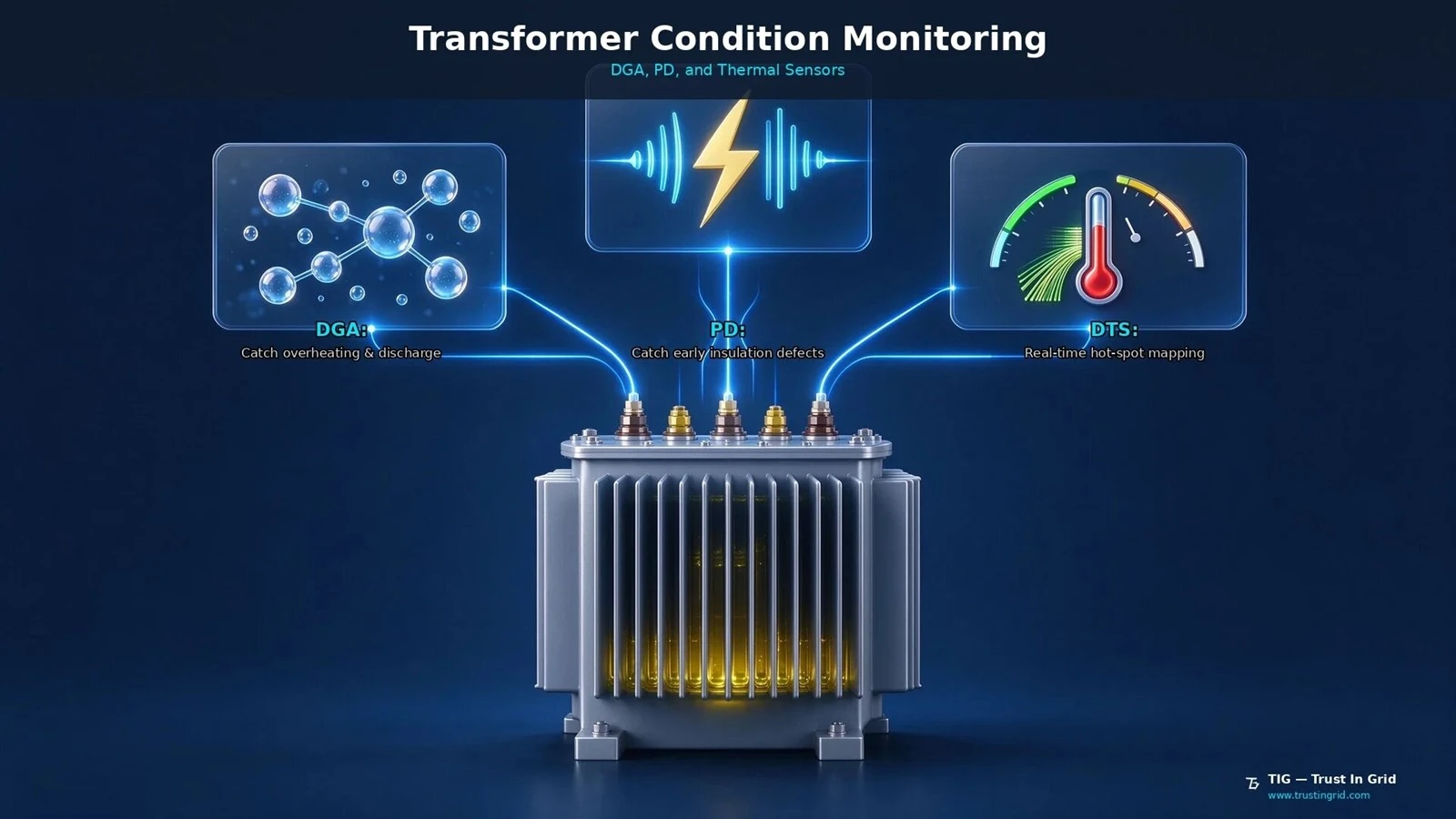
DGA is the oldest trick in the transformer monitoring book. When insulating oil overheats or discharges, it breaks down into characteristic gases: acetylene means arcing, ethylene points to high-temperature overheating, and carbon monoxide/carbon dioxide indicate solid insulation aging. IEEE C57.104 is the bible here, setting the alarm thresholds and fault-type criteria for different gas concentrations.
The core value of online DGA is the trend, not the absolute number. A single high hydrogen reading might just mean the last oil change didn't degas properly. But if hydrogen crawls from 50 μL/L to 150 μL/L over two weeks, while load and temperature haven't changed, that's a clear precursor to a fault.
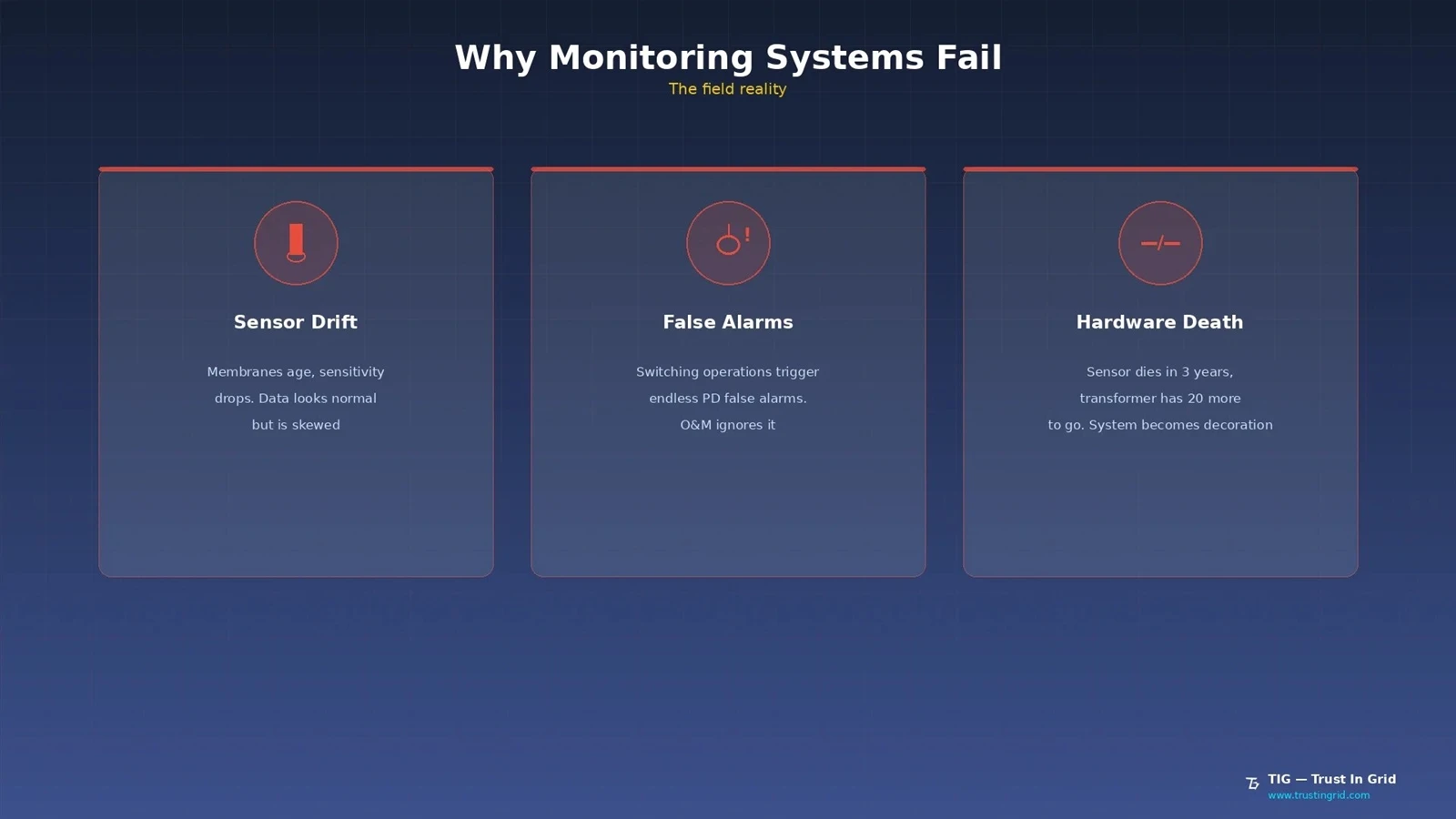
The biggest trap with online DGA is sensor drift. The gas separation membranes age, and electrochemical sensors lose sensitivity. The data looks normal, but it's actually skewed. When selecting a system, don't just look at the initial accuracy. Ask the vendor about the membrane replacement cycle and actual field lifespan. If the sensor drifts after three years, but the transformer has another twenty years to go, that system becomes a decoration for the rest of its life.
2. Partial Discharge: Great for Early Defects, Terrible for False Alarms
Partial discharge (PD) is an early sign of insulation degradation. The traditional pulse current method is only good for offline testing. Online monitoring usually relies on Acoustic Emission (AE) or Ultra-High Frequency (UHF) methods.
UHF is highly resistant to electromagnetic interference, making it great for substation environments where it can catch weak discharge signals. AE is excellent for locating the PD source, and is used on both the transformer body and bushings.
But PD monitoring has the highest false alarm rate of all online monitoring methods. Switching operations, discharges from adjacent equipment, or even nearby cell phone signals can be picked up by the sensors. If the system isn't smart enough, it will scream endlessly.
The key to killing false alarms is multi-sensor cross-validation. A single UHF alarm means nothing. You have to check data from other sensor locations to see if the same phase characteristics appear. Then you cross-reference with DGA data. If the PD alarm goes off and acetylene or hydrogen simultaneously climbs, the fault is confirmed. If only PD alarms and gases are normal, it's highly likely external interference.
Pay attention to sensor placement and anti-interference design. UHF sensors are mounted on handholes or flanges on the tank, and the location dictates how much signal it can "hear." AE sensors need good coupling, or the signal attenuates severely.
3. Temperature: The Most Basic, But It Directly Dictates Lifespan
Winding hot-spot temperature is the core variable determining insulation life. According to the IEC 60076-7 aging model, every 6K increase in winding hot-spot temperature cuts insulation life in half. This isn't a guess; it's derived from massive amounts of operating data.
Traditional temperature measurement uses top-oil temp plus a calculated winding rise, but the actual hot spot is buried inside the windings. The calculation error can exceed 10K. Distributed Temperature Sensing (DTS) buries fiber optics directly into the windings, mapping the entire temperature distribution with accuracy down to ±1°C.
For transformers that run frequently overloaded (like renewable step-ups or high-load distribution units), the value of DTS is direct. It doesn't just monitor the hot spot in real-time; it can pair with load management strategies to actively derate before the hot spot hits the warning level, preventing accelerated insulation aging.
But DTS has its limits. The fiber must be installed during the manufacturing phase; you can't retrofit it into an operating transformer. The fiber itself is fragile, and vibration or thermal expansion can cause breaks. When selecting, confirm the fiber's temperature rating and mechanical protection.
4. Data Comparison: How to Choose
| Monitoring Method | Primary Goal | Advantages | Limitations | Typical Applications |
|---|---|---|---|---|
| Online DGA | Overheating, discharge faults | Mature tech, complete standards, reflects multiple fault types | Sensors drift easily, requires regular calibration/replacement | Hub mains, offshore step-ups, EHV transformers |
| PD Monitoring (UHF/AE) | Early insulation defects | Catches early faults, can locate the source | High false alarm rate, strict anti-interference requirements | HV/EHV transformers, critical substations |
| Fiber-Optic Temp (DTS) | Winding hot-spot | High accuracy, direct internal measurement | Must be embedded at manufacturing, fragile fiber | Renewable step-ups, high-load distribution, frequent overloads |
These three aren't alternatives; they complement each other. DGA tells you if a qualitative change has occurred, PD tells you if the insulation is degrading, and temperature tells you how fast it's aging. Only by combining all three do you get the full picture of the transformer's health.
5. How to Build a System That Doesn't Become Decoration
Plenty of monitoring projects fail, not because the sensors are bad, but because the system design is flawed.
First, data fusion must happen at the front end. If DGA, PD, and temperature are three independent systems, the O&M crew has to stare at three different screens and manually cross-reference. That system is doomed to be abandoned. The edge computing gateway should align the multi-source data locally, filter noise, and generate a consolidated alert.
Second, alarm logic must be tiered. A single parameter crossing a threshold triggers a yellow warning. Multiple parameters exceeding limits together trigger a red warning. Don't treat every alarm as a critical emergency; you'll drive the O&M team insane.
Third, hardware reliability beats algorithm intelligence. No matter how smart the model is, if the sensor feeds it garbage, the result is garbage. When selecting, treat the sensor's MTBF (Mean Time Between Failures) and replacement cycle as hard requirements.
6. Where It Makes Sense
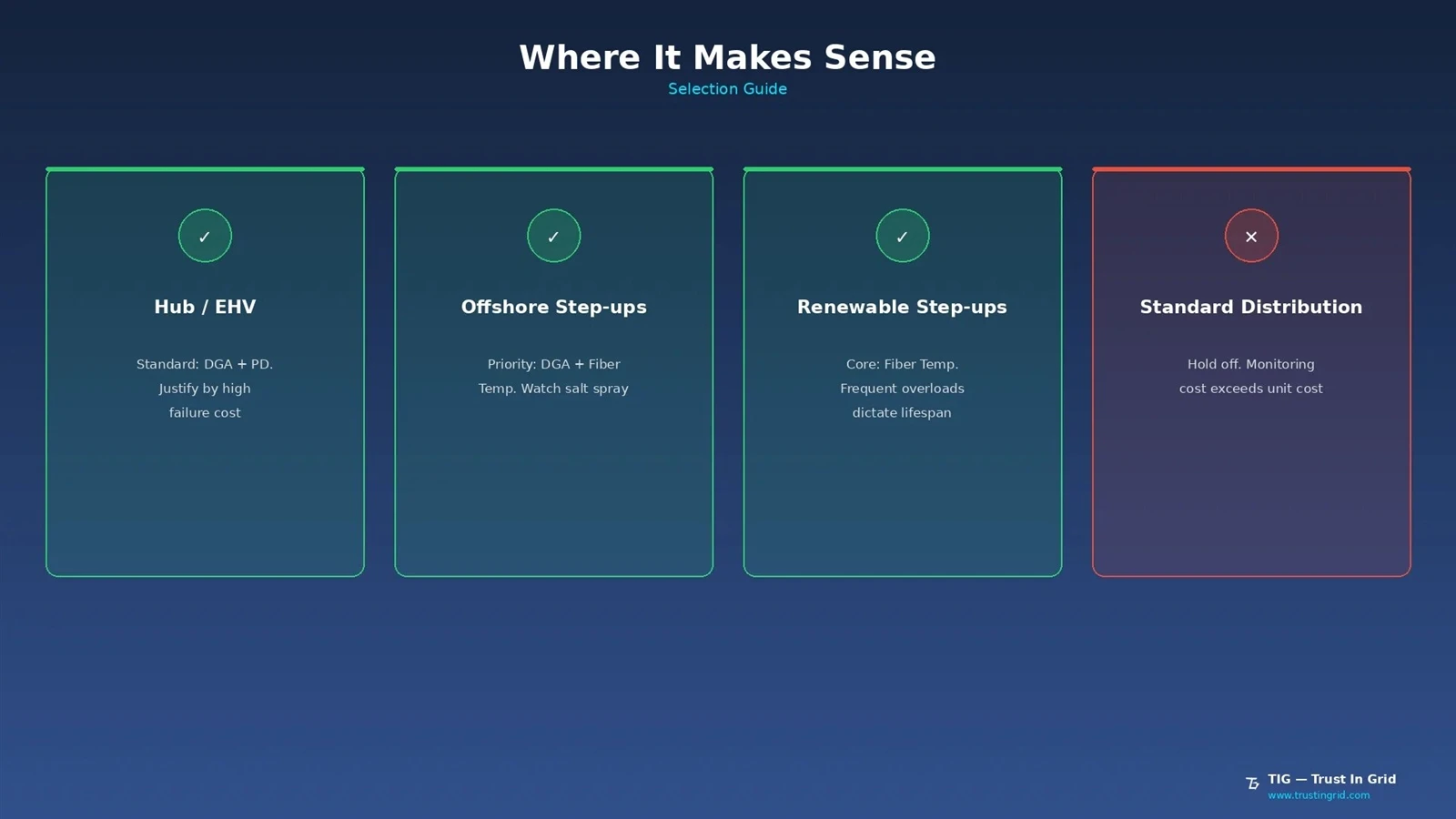
Hub mains / EHV transformers: Online DGA + Online PD is standard. The failure cost here is too high; the monitoring investment is entirely justified. Temperature monitoring via fiber or PT100 works, but focus on the combined DGA/PD judgment.
Offshore step-up transformers: Prioritize DGA and fiber-optic temp. Offshore maintenance costs are astronomical. DGA catches internal overheating and discharge early, while fiber temp monitors overload conditions. Add PD if you can, but choose models that resist salt spray corrosion.
Renewable step-ups (PV/Wind): Fiber-optic temp is the core. Renewable duty cycles swing wildly, transformers face frequent overloads, and hot-spot temperature directly dictates lifespan. DGA and PD are auxiliary.
Standard distribution transformers: Hold off. If it's just a standard distribution unit, the failure impact is small, and the cost of a monitoring system might exceed the transformer itself. Periodic inspections and offline testing are enough.
We build transformers and supply core materials. If you are evaluating transformer designs or specifications for condition monitoring applications-whether it's ensuring sensor compatibility during manufacturing, selecting core materials for high-reliability units, or optimizing thermal design for DTS integration-send us your details. Transformer type, voltage level, monitoring requirements, volume, timeline. You will get a straight answer.
TIG - Trust in Grid
www.trustingrid.com
asia@trustingrid.com
References
[1] IEEE Std C57.104-2019, IEEE Guide for the Interpretation of Gases Generated in Mineral Oil-Immersed Transformers, IEEE Standards Association.
[2] IEC 60076-7:2018, Power transformers - Part 7: Loading guide for mineral-oil-immersed power transformers, IEC.
[3] Online Monitoring of Power Transformers: A Review, IEEE Transactions on Power Delivery, 2022.
[4] Application of Distributed Optical Fiber Temperature Sensing in Transformer Windings, IEEE Sensors Journal, 2021.
[5] Partial Discharge Detection in Power Transformers: A Review of UHF and AE Methods, IEEE Transactions on Dielectrics and Electrical Insulation, 2023.
[6] Current Status and Development Trends of Condition Monitoring Technology for Power Transformers, High Voltage Apparatus, 2023.