


What Is a Smart Transformer? IoT, Sensors, and Real-Time Monitoring Explained
Walk around any industry expo and almost every transformer manufacturer has "Smart Transformer" plastered on their booth. Sometimes it means a distribution box with a temperature sensor slapped on. Sometimes it means a unit with a communication module. Sometimes it's a solid-state transformer with active voltage regulation.
The term gets thrown around so loosely that buyers and utility engineers are often left scratching their heads: does "smart" actually mean anything beyond bolting a thermometer to the tank, or does it fundamentally change how you run the asset?
This article skips the buzzwords. Here is what a smart transformer actually looks like from an engineering standpoint, where the sensor value really lies, and how to avoid paying the "smart" premium for features you will never use.
1. The Three Levels of "Smart"
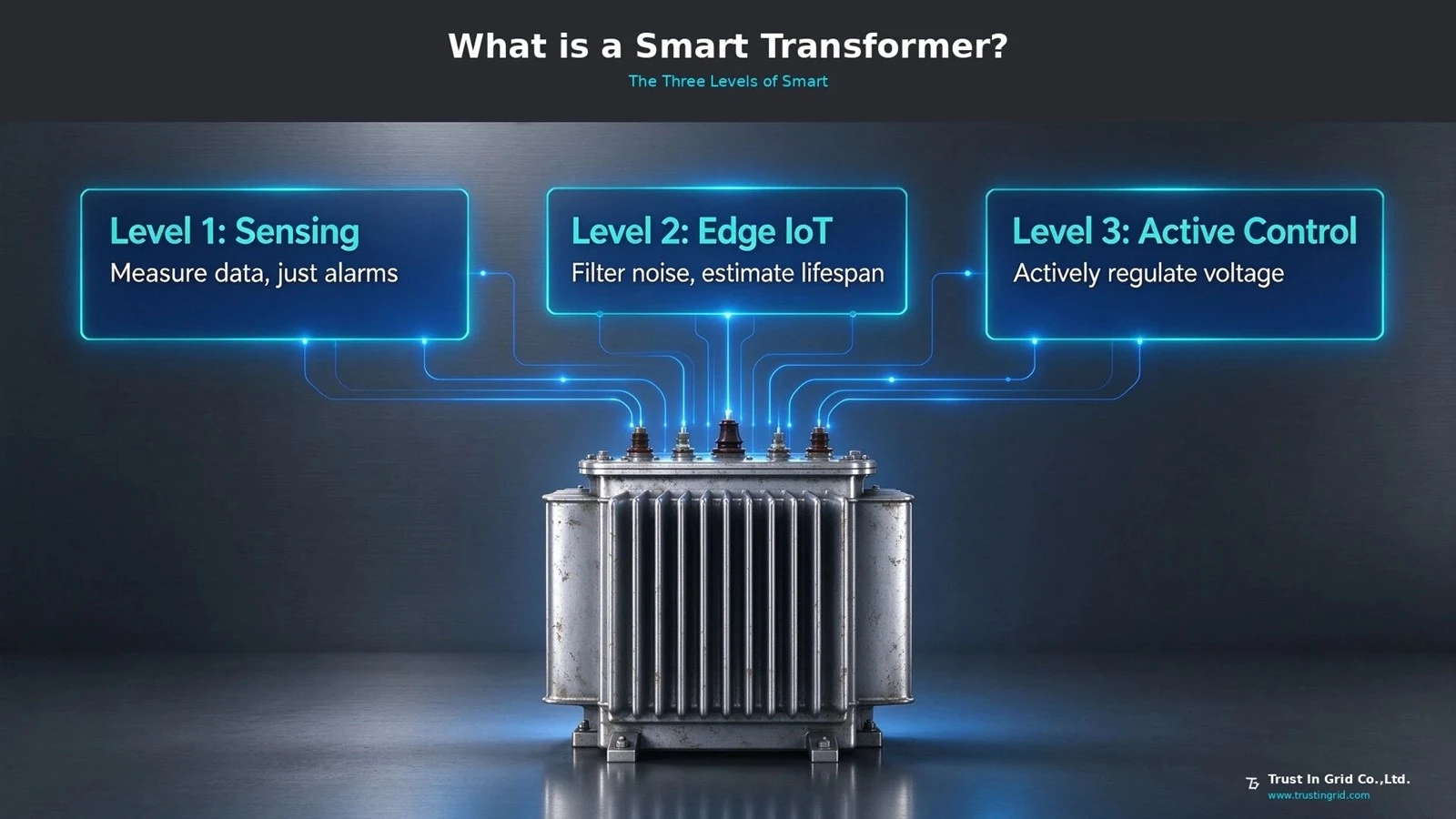
The industry definition is vague, but in practice, it breaks down into three stacked levels.
Level 1: Sensing & Telemetry. This is the basic version. You bolt sensors onto a conventional transformer to measure top-oil temp, winding temp, oil level, or gas pressure. If you're fancy, you add online DGA (dissolved gas analysis) or PD (partial discharge) monitoring. The core function is "seeing." Data that used to require a guy with a handheld meter walking out to the site is now a real-time number on a screen. It does not control anything; it just alarms.
Level 2: Edge Computing & IoT. This is what most major manufacturers push today. Beyond measuring data, the transformer gets a "brain" (an intelligent terminal or edge gateway). It processes data locally-filtering out sensor noise, running trend analysis-and pushes the cleaned data to the cloud via protocols like IEC 61850 or MQTT. It starts to "think." It can filter false alarms and estimate lifespan based on load profiles.
Level 3: Active Control. This is true "intelligence." The transformer is no longer a passive iron block; it actively intervenes in the grid. Think electronic on-load tap changers (OLTC) regulating voltage in milliseconds, or solid-state transformers (SST) providing bidirectional AC/DC power flow control. It can "act," solving voltage fluctuations caused by high renewable penetration.
Before buying, ask yourself: which level does the project actually need? If you just want to replace manual meter reading, Level 1 is enough. If you're fighting voltage violations from solar reverse power, you might have to jump straight to Level 3.
2. What Sensors Are Actually Worth Installing
Smart transformers run on data, and data comes from sensors. Install too many and you waste money. Install the wrong ones and you waste even more.
| Sensor Type | What It Measures | Engineering Value | Recommended Scenario |
|---|---|---|---|
| PT100 / Fiber-Optic Temp | Top-oil and winding hot-spot | Evaluates insulation aging, prevents overload burnout | All scenarios, especially overload-prone distribution |
| Online DGA | Hydrogen, acetylene, CO, etc. | Catches arcing or overheating weeks in advance | Hub substation mains, offshore wind step-ups |
| UHF/AE Partial Discharge | Internal insulation discharge signals | Early insulation defect localization | HV / EHV transformers |
| Bushing Tanδ Monitoring | Bushing capacitance and dissipation factor | Prevents bushing moisture or explosion | 110kV+ main transformers |
| Vibration / Noise | Core and winding mechanical state | Detects DC bias or winding loosening | Converter transformers, large power transformers |
| Temp/Humidity / Water | Transformer room environment | Prevents flashover from condensation | Outdoor box transformers, underground vaults |
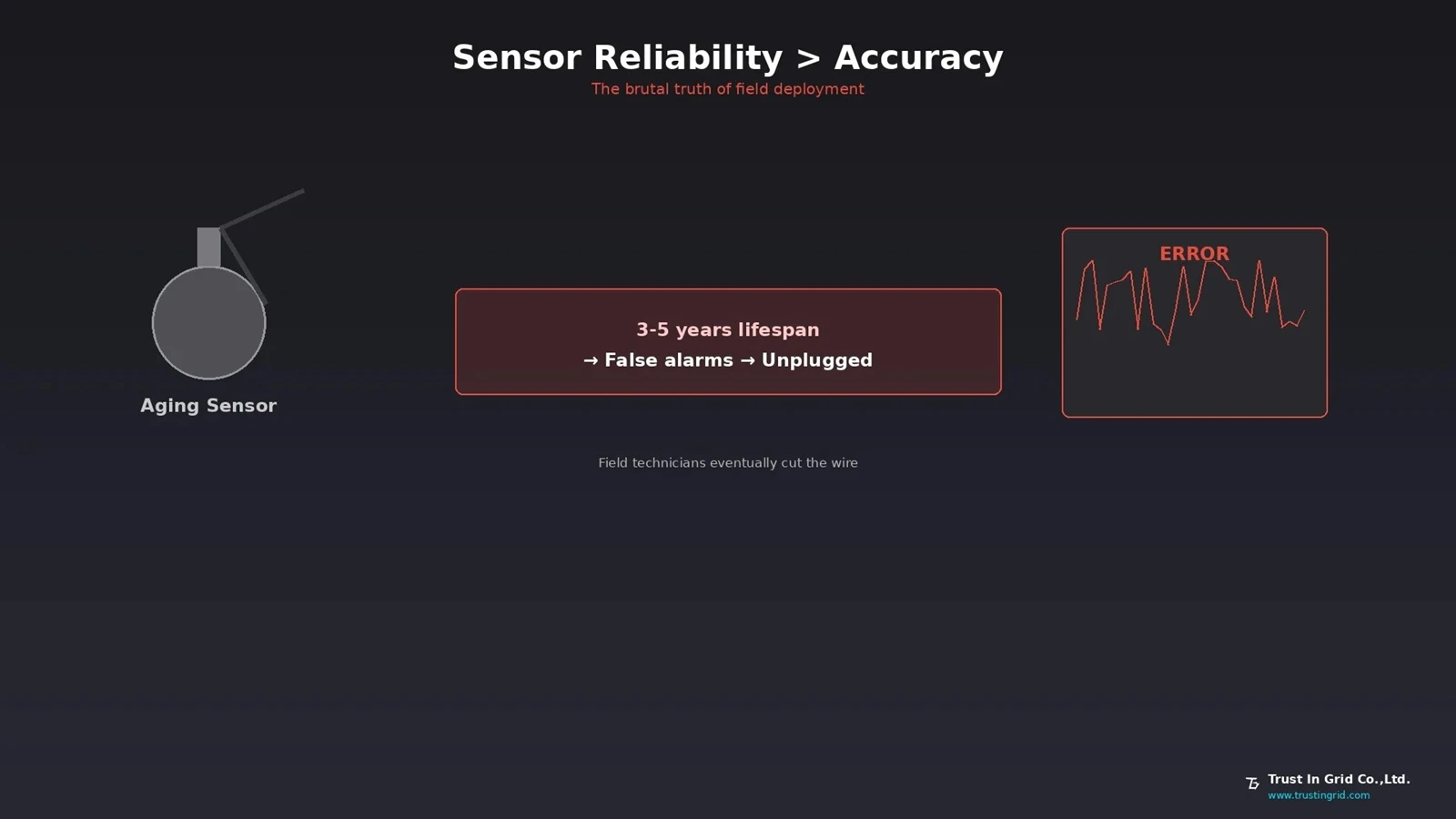
The core logic for sensors is simple: can this parameter catch a fatal fault early, and will the sensor itself survive? Plenty of projects install online DGA, only to have the probe drift in three to five years. The system spams false alarms, the O&M crew gets annoyed, and eventually, someone just unplugs the alarm wire. Sensor reliability matters more than sensor accuracy.
3. Real-Time Monitoring: From "Scheduled Checkups" to "Predictive Maintenance"
Traditional O&M logic is: take an outage, run tests, put it back. The problem is, transformer degradation is continuous. What happens between those tests is a black box.
Smart monitoring flips this from reactive repair to predictive maintenance. How does it actually work?
Edge Filtering: The local smart terminal filters out obvious noise (like transient temp spikes from switching operations).
Cloud Modeling: Uploaded data is combined with historical ledgers, load curves, and ambient temps to build a dynamic baseline. If acetylene creeps up but load and ambient temp haven't changed, the system automatically bumps the alert level.
Multi-Source Cross-Validation: A rising oil temp could be an overload, or it could be internal overheating. A smart system checks PD and DGA simultaneously. If PD and DGA are normal and only the temp is high, it infers overload and recommends shifting load. If temp spikes, PD surges, and gas goes crazy, it pushes a "internal fault-recommend immediate outage" alert.
Without multi-source cross-validation, your "smart monitoring" is just an expensive digital dashboard.
4. IEC 61850 and the Data Silo Problem
For a smart transformer to work, it must integrate with the grid's communication network.
The core substation communication standard is IEC 61850. It defines the data models for transformers, breakers, and protection relays. A smart transformer's terminal must speak this protocol to feed data seamlessly into the utility's SCADA system.
But that's just the hardware layer. The real bottleneck is the data silo. Plenty of utilities have advanced online monitoring systems, but the monitoring software, the asset ledger, and the maintenance schedule are three totally different platforms. The O&M guy sees an alert and has to manually look up when this transformer was last serviced.
If the smart transformer data can't talk to the Enterprise Asset Management (EAM) system, "smart O&M" is a fantasy.
5. What Fits Where
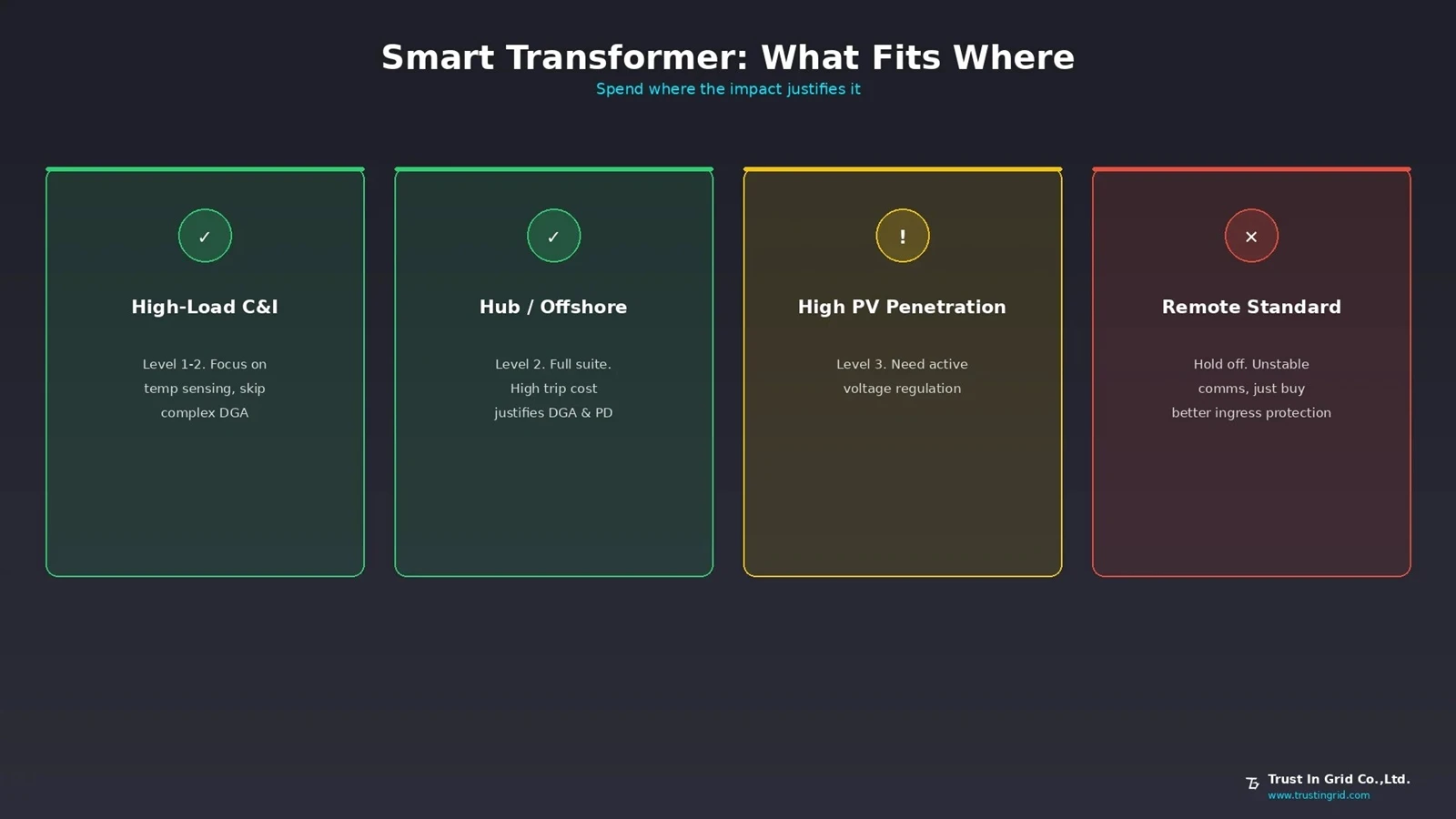
High-load/high-overload C&I distribution: Level 1 to Level 2. Focus on fiber-optic or PT100 temp sensing for real-time hot-spot monitoring, paired with load management. Skip the complex DGA.
Hub substations / offshore wind step-ups: Go straight to Level 2, full suite. DGA, PD, fiber-optic temp, and bushing tanδ are standard, paired with the smart terminal. When these units trip, the cost is astronomical, so pay for the early warning.
Distribution areas with high distributed PV penetration: Look at Level 3. Either a smart transformer with electronic voltage regulation or a smart terminal driving a standard OLTC. Solve the voltage violations from midday reverse power flow.
Remote standard distribution transformers: Hold off. Unstable comms networks mean you can't get the data out anyway. Put the budget into higher ingress protection on the transformer itself. If it breaks, just swap it.
We build transformers and supply core materials. If you are evaluating transformer designs or specifications for smart grid or IoT-ready projects-whether it's integrating monitoring sensors during manufacturing, selecting core grade for advanced transformers, or optimizing loss targets-send us your details. Transformer type, voltage level, communication requirements, volume, timeline. You will get a straight answer.
TIG - Trust in Grid
www.trustingrid.com
asia@trustingrid.com
References
[1] IEC 61850-7-3:2010, Communication networks and systems for power utility automation - Part 7-3: Basic communication structure - Common data classes, IEC.
[2] IEEE Std C57.143-2012, IEEE Guide for Application for Monitoring Equipment to Liquid-Immersed Transformers and Components, IEEE Standards Association.
[3] Smart Transformers: A Review of Architectures, Applications, and Future Trends, IEEE Transactions on Power Electronics, 2023.
[4] IoT-Enabled Condition Monitoring of Power Transformers: A Review, IEEE Internet of Things Journal, 2022.
[5] Power Transformer Condition Assessment and Prediction Based on Multi-Source Data Fusion, Automation of Electric Power Systems, 2023.
[6] Real-time Monitoring and Diagnosis of Transformers Based on Distributed Temperature Sensing, IEEE Transactions on Power Delivery, 2021.