


Digitalization and Smart Monitoring: Moving Transformers from "Scheduled Checkups" to "Real-Time Alerts"
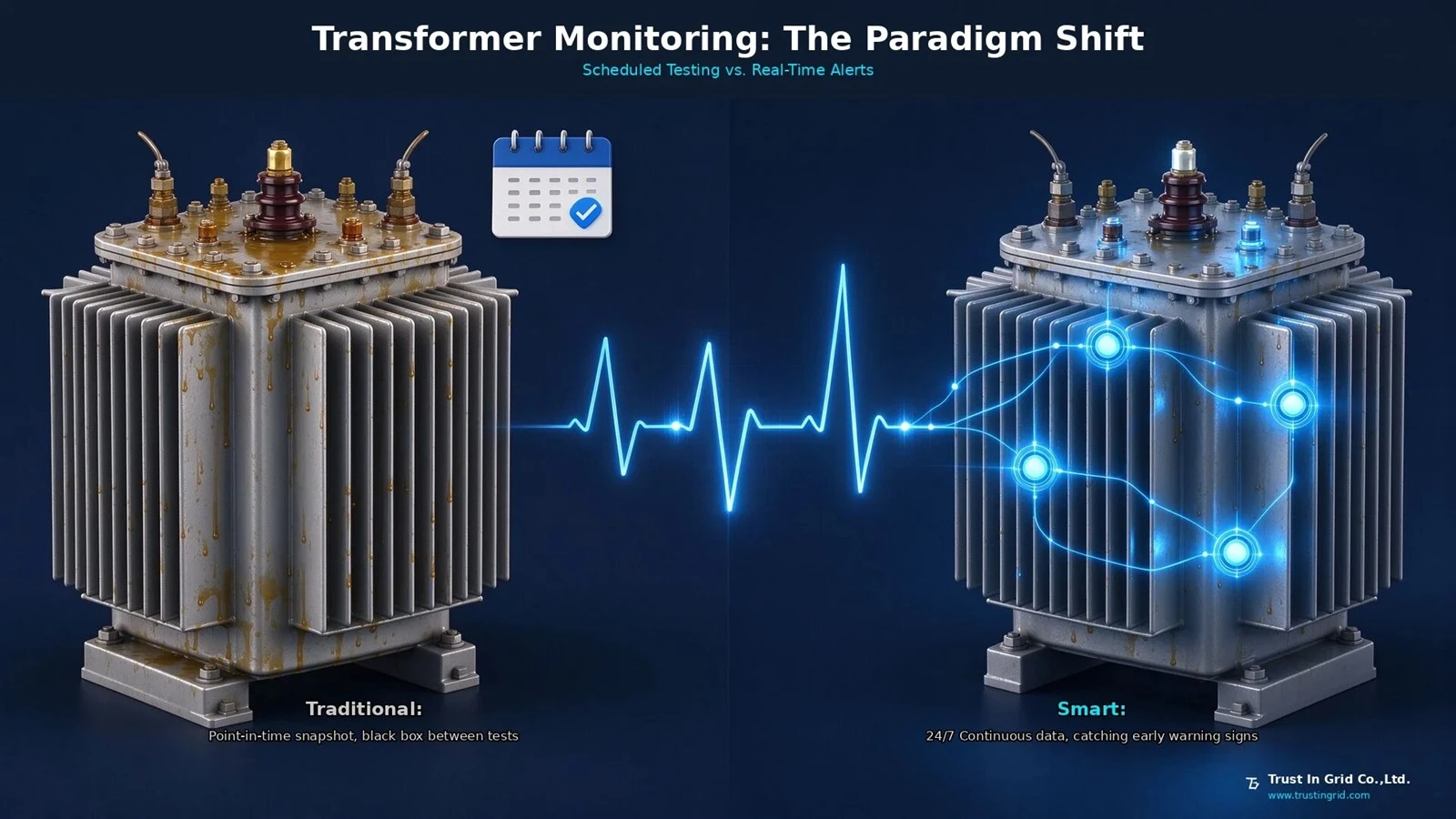
In the past, the default logic was: fix it when it breaks. We did scheduled offline preventive tests-measuring insulation resistance, running dissolved gas analysis (DGA)-and if the numbers looked good, we put it back in service. The problem? Preventive testing is a snapshot in time, but transformer degradation is continuous. What happens between those two tests is a black box.
Smart monitoring changes the logic. Sensors are online 24/7, data streams in real-time, and algorithms analyze the trends in the background. A transformer's status goes from a binary "pass/fail on a specific day" to a continuous curve. Failures don't happen out of nowhere; they build up slowly. The whole point of monitoring is to catch the warning signs before it turns into an incident.
This article skips the grand narrative of the Industrial IoT. It's a practical look at how smart monitoring actually lands in the field, what parameters are worth measuring, and where your money is best spent.
1. What Are We Actually Measuring?
There are dozens of parameters you can measure inside a transformer, but not all of them are worth putting online. The selection criteria are simple: can this parameter reflect the fault trend early enough, and is the sensor reliable enough not to become a liability?
Dissolved Gas Analysis (DGA). This is the core of online transformer monitoring. When insulating oil overheats or discharges, it breaks down into characteristic gases. Different fault types produce different gas profiles. Traditionally, you pull an oil sample and send it to a lab. Now, online DGA sensors continuously monitor key gases (hydrogen, carbon monoxide, acetylene, etc.). Acetylene is a massive red flag for arcing; once it shows up, the O&M team might only have a few hours to react.
Partial Discharge (PD). PD is an early sign of insulation degradation, but the traditional pulse current method requires an outage. Modern online PD monitoring usually relies on Acoustic Emission (AE) or Ultra-High Frequency (UHF) methods. UHF is highly resistant to electromagnetic interference, making it great for substations. AE is good for locating the PD source. The challenge for both is the complex electromagnetic noise on-site, which easily triggers false alarms.
Fiber-Optic Temperature Sensing. Winding hot-spot temperature is the critical variable for insulation life, but the hot spot is buried inside the windings where standard thermometers can't reach. Distributed Temperature Sensing (DTS) buries fiber optics directly into the windings to map the entire temperature distribution in real-time. Compared to guessing from top-oil temperature, DTS data is direct.
Bushing Insulation Parameters. Bushings are a high-failure-rate component. Online monitoring of bushing tanδ and capacitance can catch moisture ingress or insulation aging before it fails.
2. Data Comparison: Traditional O&M vs. Smart Monitoring
| Dimension | Traditional Scheduled Testing | Online Smart Monitoring |
|---|---|---|
| Data Frequency | 1-2 times per year | Continuous (seconds/minutes) |
| Fault Detection Timing | Post-event or near failure | Early degradation phase |
| Outage Requirement | Mandatory outage | No outage required |
| Typical Cost Profile | Low testing fee, high outage cost | High upfront sensor/system cost |
| Data Granularity | Point-in-time snapshot | Trend curves and multi-source correlation |
| False Alarm Handling | Manual review | Requires algorithmic filtering and cross-validation |
You spend your money where it counts. For a standard distribution transformer, the impact of a failure is small and repair is cheap. Stacking it with high-precision sensors doesn't make financial sense. But for main substation transformers, offshore wind step-ups, or grid hubs, the cost of one unplanned outage dwarfs the cost of the monitoring system.
3. What is "AI" Actually Doing Here?
These days, if a monitoring system doesn't slap an "AI Algorithm" sticker on the box, it feels like it can't be sold. But in this field, AI's actual job falls into three buckets.
Bucket 1: Threshold Alarms (The Basics). If acetylene exceeds 5 μL/L, send an SMS. This is just an if-then logic rule. No AI needed. But it solves the problem of "no human is staring at the screen 24/7."
Bucket 2: Trend Prediction (Somewhat Useful). Fitting historical data to predict where a gas or temperature is heading. This often crashes and burns because transformer operating conditions (load, ambient temp) change constantly. Simple linear extrapolation generates a ton of false positives.
Bucket 3: Multi-Source Data Fusion (The Real Deal). Feeding DGA, PD, temperature, and load curves into a model, combined with transformer topology and historical fault libraries, to determine if the alarm is a "broken sensor," a "temporary spike from hot weather," or "actual internal overheating." This requires massive amounts of real fault data for training. You can't just tweak parameters on an open-source algorithm and call it a day.
4. Three Traps in Field Deployment
Buying a fancy system that gets abandoned after a year is a common story. The problems usually boil down to these three areas.
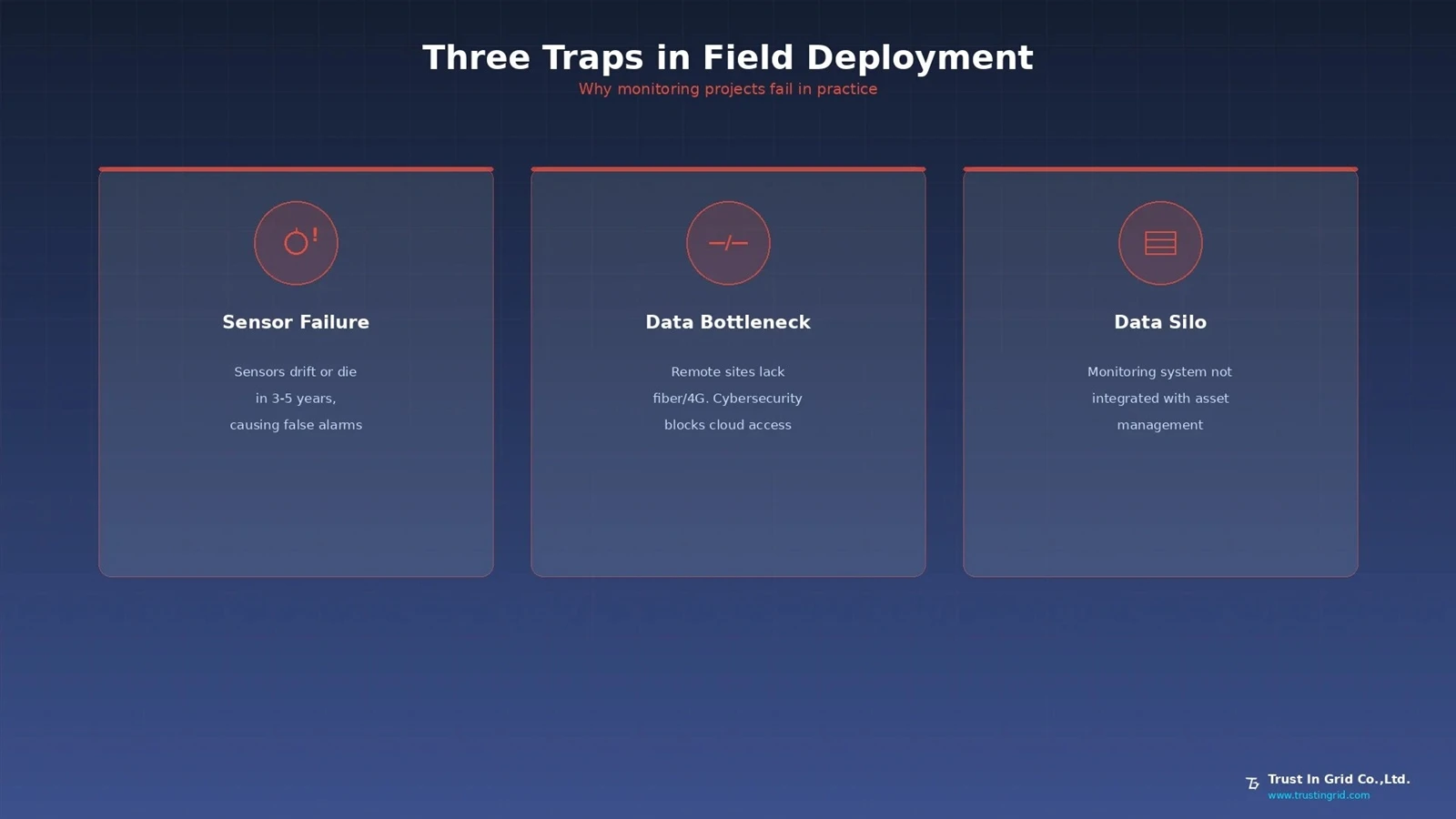
First, the sensor dies before the transformer does. A transformer is designed for 30+ years. Online sensors (especially those sitting in the oil path) might drift or fail in three to five years. Once the sensor fails, if the system keeps reporting garbage data, it triggers a false alarm. The O&M crew rushes to the site, finds nothing wrong, and loses all trust in the system. Sensor reliability matters more than sensor accuracy.
Second, the data can't get out. Many remote substations lack stable fiber networks. Relying on 4G is expensive and unreliable. Then there's data security. Utilities have strict cybersecurity requirements. Getting transformer data securely and compliantly to a cloud platform is often a bureaucratic nightmare between the IT and OT departments.
Third, the system becomes a data silo. The monitoring system throws an alert, but the defect management system, the asset ledger, and the maintenance schedule are sitting in a totally different software. The O&M guy sees the alert and has to manually look up when this transformer was last serviced. If smart monitoring isn't integrated with the asset management system, it's nothing more than an expensive dashboard.
5. Where It Makes Sense
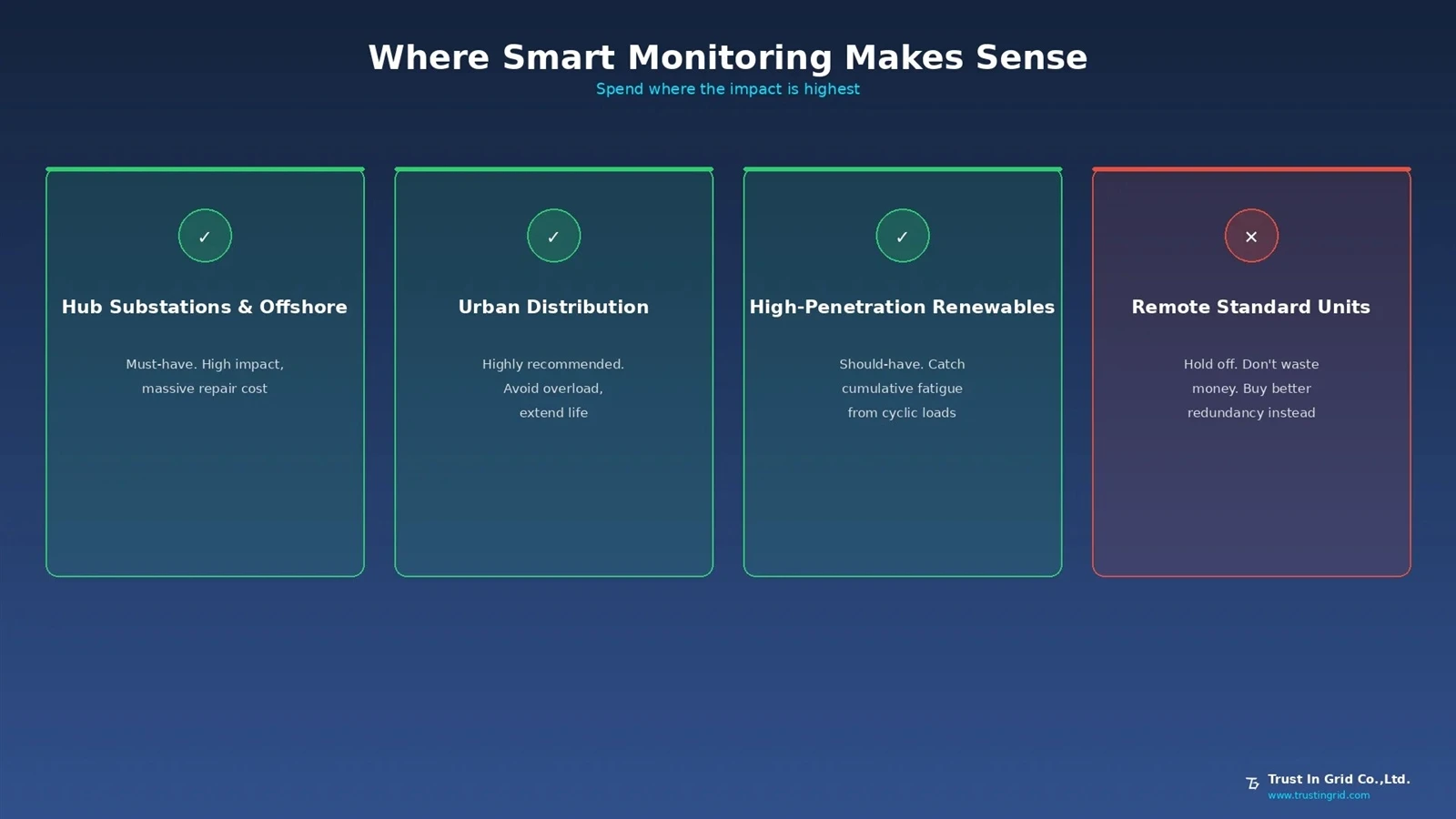
Hub substation main transformers, offshore wind step-ups: Must-have. Not just any system, but a good one. Online DGA and PD are baseline, paired with fiber-optic temp sensing. When one of these trips, the impact is massive, and the repair bill is astronomical.
Urban center distribution stations (noise and outage sensitive): Highly recommended. Focus on load rate and hot-spot temperature. Use the data to drive operational strategy and avoid overloads.
Transformers in high-penetration renewable areas: Should-have. With PV and storage, these transformers face rapid power flips and cyclic overloads. The duty cycle is much harsher than a standard grid. Periodic checks won't catch cumulative fatigue.
Remote standard distribution transformers: Hold off. If access is difficult and there's no reliable network, spending money on sensors that will drift or fail isn't smart. Put that budget into higher redundancy and better ingress protection on the transformer itself. If it breaks, just swap it.
We build transformers and supply core materials. If you are evaluating transformer designs or specifications for projects that require advanced monitoring readiness-such as sensor placement during manufacturing, or core material selection-send us the details. Transformer type, application, load profile, timeline. You will get a straight answer.
TIG - Trust in Grid
www.trustingrid.com
asia@trustingrid.com
References
[1] Online Monitoring of Power Transformers: A Review, IEEE Transactions on Power Delivery, 2022.
[2] Application of Distributed Optical Fiber Temperature Sensing in Transformer Windings, IEEE Sensors Journal, 2021.
[3] AI-Based Fault Diagnosis for Power Transformers Using Dissolved Gas Analysis, IEEE Transactions on Dielectrics and Electrical Insulation, 2023.
[4] Current Status and Development Trends of Online Monitoring Technology for Power Transformers, High Voltage Apparatus, 2023.
[5] IEC 60270:2000, High-voltage test techniques - Partial discharge measurements, IEC.
[6] IoT-Based Smart Monitoring System for Distribution Transformers, IEEE Internet of Things Journal, 2022.