


Solid-State Transformers (SST): The Next Disruption in Power Distribution
"SSTs (Solid-State Transformers)-or PETs-have been hyped by the industry for nearly 20 years." Every few years, there's a wave of news claiming it's about to disrupt the traditional transformer market. But if you ask a frontline distribution engineer today, most will just tell you: "Wake me up when it gets cheaper and stops blowing up."
It's a blunt response, but it hits the nail on the head. Theoretically, SSTs are far more advanced than conventional iron-core transformers: smaller footprint, more functions, active voltage control. But from an engineering execution standpoint, SSTs are still stuck in the "impressive in pilot projects, painful for mass adoption" phase.
This article skips the hype. It's a straight engineering look at what SSTs can do, what they can't, and when you actually need one.
1. How SSTs Actually Work
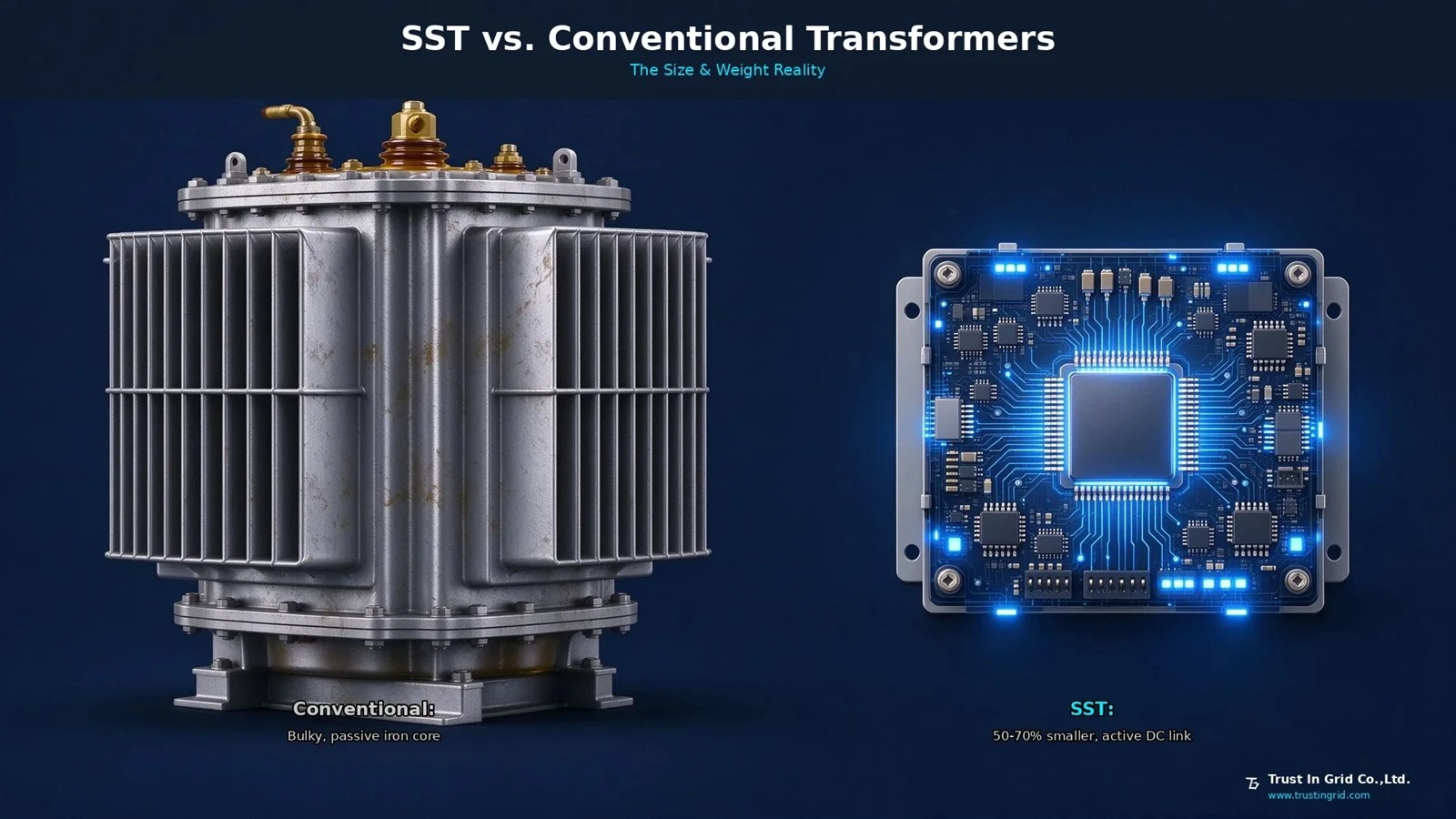
A traditional transformer relies on Faraday's law of induction-iron core plus copper wire, operating at 50/60Hz. It's simple, rugged, handles overloads well, and pushes efficiency past 99%. The downsides? It's bulky, heavy, and only passively transforms voltage.
SSTs flip the logic. They rectify the grid AC into DC, step it up or down through a high-frequency transformer (usually 10kHz to 100kHz+), and then invert it back to grid AC. Because the frequency is so high, the magnetic core and windings can be tiny. Volume and weight can drop by 50% to 70% compared to a conventional transformer of the same rating.
More importantly, it has a "DC link" in the middle. This link turns it from a passive iron block into an active power electronics device. It can isolate harmonics, dynamically regulate voltage, limit short-circuit currents, and even provide both AC and DC ports simultaneously. For a distribution grid now packed with solar, storage, and EV chargers, this sounds like a dream machine.
2. SST vs. Conventional Transformers: The Hard Numbers
Don't look at the feature list on the PowerPoint slide. Look at the hard specs on site.
| Parameter | Conventional Oil/Dry Transformer | Solid-State Transformer (SST) |
|---|---|---|
| Efficiency (Full Load) | 98.5% – 99.3% | 97% – 98.5% |
| Volume & Weight | Baseline (big and heavy) | Reduced by 50% – 70% |
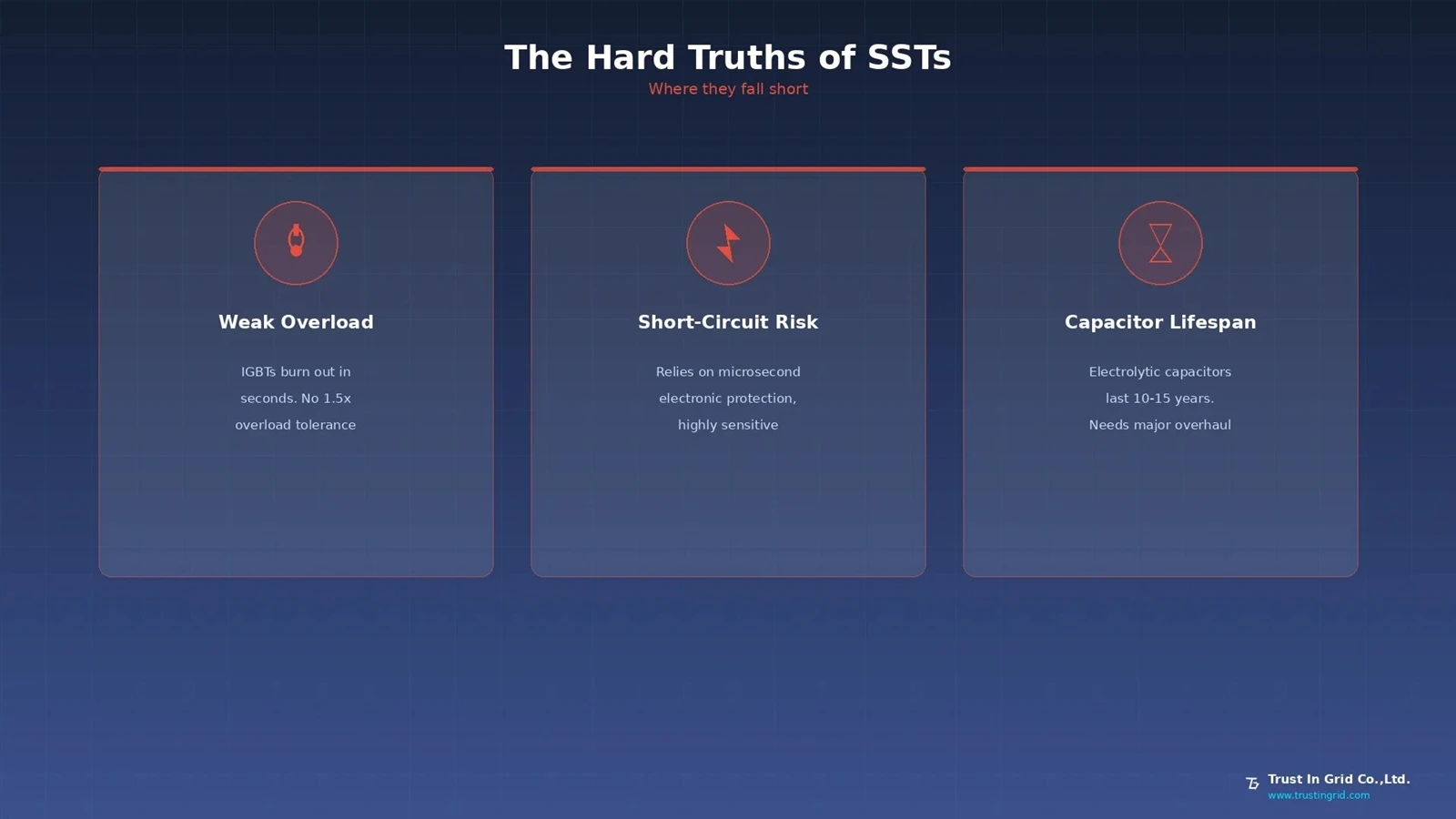
| Overload Capability | Extreme (1.5x+ short-term) | Weak (limited IGBT thermal mass, easily fried) |
| Short-Circuit Tolerance | Strong (limited by its own impedance) | Weak (relies on microsecond electronic protection) |
| Voltage Regulation | Passive (mechanical OLTC) | Active (millisecond-level, stepless) |
| Functional Extension | Single (voltage transformation only) | Multi-functional (reactive power, harmonic filtering, AC/DC ports) |
| Initial Cost | Low | Extremely high (3x to 5x conventional for same rating) |
| Reliability | Very high (decades of life) | Unproven (limited by electrolytic caps and semiconductor lifespan) |
The killers on this list are "Efficiency" and "Short-Circuit Tolerance."
Conventional transformers push past 99% full-load efficiency. SSTs go through AC-DC-AC multi-stage conversion, so losses are inherently higher. While the latest SiC (silicon carbide) devices have pushed efficiency to around 98.5%, in large-capacity scenarios, that fraction of a percent loss gap translates into real money over a decade.
The bigger headache is overload. A conventional transformer can take 1.5x or even 2x overload for a short period; it just runs a bit hotter and survives. If an IGBT in an SST overloads, it burns through in seconds. The SST protection system has to be incredibly fast, meaning it is highly sensitive to grid transients.
3. Standards Are Still Catching Up
In the conventional transformer world, IEC 60076 is king. But SSTs straddle both transformers and power electronics, leaving the existing standards struggling to keep up.
Right now, the IEC is working on IEC 60076-26, specifically targeting power electronic transformers. IEEE has related drafts (like the IEEE 1547 series for smart inverters, which partially applies). But overall, SST testing standards, acceptance specs, and grid codes are nowhere near as mature as those for traditional transformers.
If you are deploying an SST project today, the biggest headache isn't buying the hardware; it's that the local utility might have no idea what standard to use to approve it.
4. Where They Actually Fit Today
Current SST projects are mostly niche: "money is no object, and a conventional transformer just won't work."
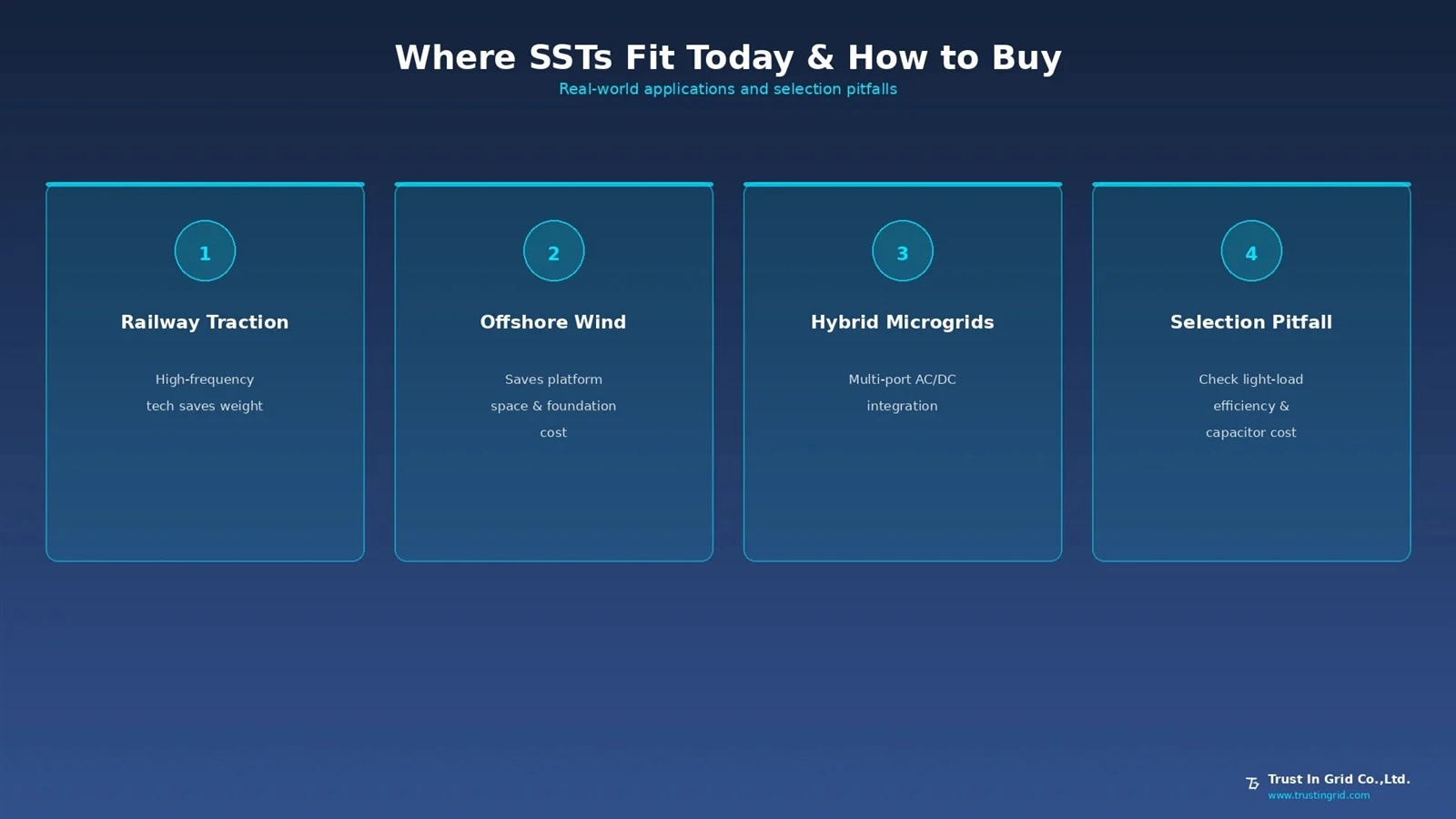
Railway Traction Systems: This is the most mature commercial application. High-speed rail auxiliary converters have long used high-frequency tech to replace bulky power-frequency transformers just to save weight.
Offshore Wind Platforms: Platform space on an offshore substation is measured in inches, and weight dictates foundation costs. SSTs are small and light, saving massive amounts of steel. The catch? Corrosion protection and thermal management in a marine environment.
Hybrid AC/DC Microgrids: A campus with both AC loads (HVAC, motors) and DC loads (data centers, EV chargers, solar). The multi-port nature of an SST fits perfectly, cutting out tons of extra converters.
Urban Center Substations: Prime real estate in a CBD. A conventional transformer plus fire suppression takes up a huge footprint. SSTs are oil-free and compact enough to shove into a basement. But high cost and weak overload capacity keep utilities hesitating.
5. Selection Pitfalls to Avoid
If you are seriously considering an SST, don't be fooled by the manufacturer's spec sheet. Drill down on these three questions:
First, don't buy the "perfect efficiency" pitch. Ask for the efficiency curve across the actual load profile, especially at light and half load. SST efficiency often drops off a cliff at light loads. If your load curve swings wildly, an SST might actually burn more energy than a traditional transformer.
Second, interrogate the short-circuit protection logic. SSTs can't handle short circuits well; they rely on semiconductors to cut the fault in microseconds. Ask for actual short-circuit test reports. See if it survives extreme faults without blowing up.
Third, check the capacitor lifespan. The DC link in an SST is packed with electrolytic capacitors. These are consumables, usually rated for 10 to 15 years. A traditional transformer lasts 40 years. At year 10, your SST might need a massive capacitor replacement overhaul. You must bake that cost into your total life-cycle math.
We build transformers and supply core materials. If you are evaluating transformer specs for a project-whether traditional, hybrid, or evaluating SST integration-send us the details. Voltage level, application, load profile, timeline. You will get a straight answer.
TIG - Trust in Grid
www.trustingrid.com
asia@trustingrid.com
References
[1] State of the Art of Solid-State Transformers: A Review, IEEE Transactions on Power Electronics, 2023.
[2] Solid State Transformer (SST) Market Report 2025-2030, Grand View Research, 2025.
[3] IEC 60076-26:2020, Power transformers - Part 26: Functional requirements of power electronics transformers, IEC.
[4] Medium Voltage Solid State Transformer for Extreme Fast Charging, IEEE Applied Power Electronics Conference, 2021.
[5] Efficiency Optimization and Thermal Management of Power Electronic Transformers Based on SiC Devices, Transactions of China Electrotechnical Society, 2024.
[6] Solid-State Transformers: A Review of Architectures and Applications in Smart Grids, Renewable and Sustainable Energy Reviews, 2024.