


Digital Twins in Transformer Asset Management: From Design to Retirement
The term "Digital Twin" has been floating around the power equipment industry for years. Most of the time, it's packaged as an all-powerful 3D visualization model spinning around on a screen. It looks cool, but in actual O&M, aside from being a fancy background for PowerPoint presentations, it often doesn't solve any real problems.
This is the biggest awkwardness of digital twins in the transformer world right now: endless concepts, but very little real-world execution.
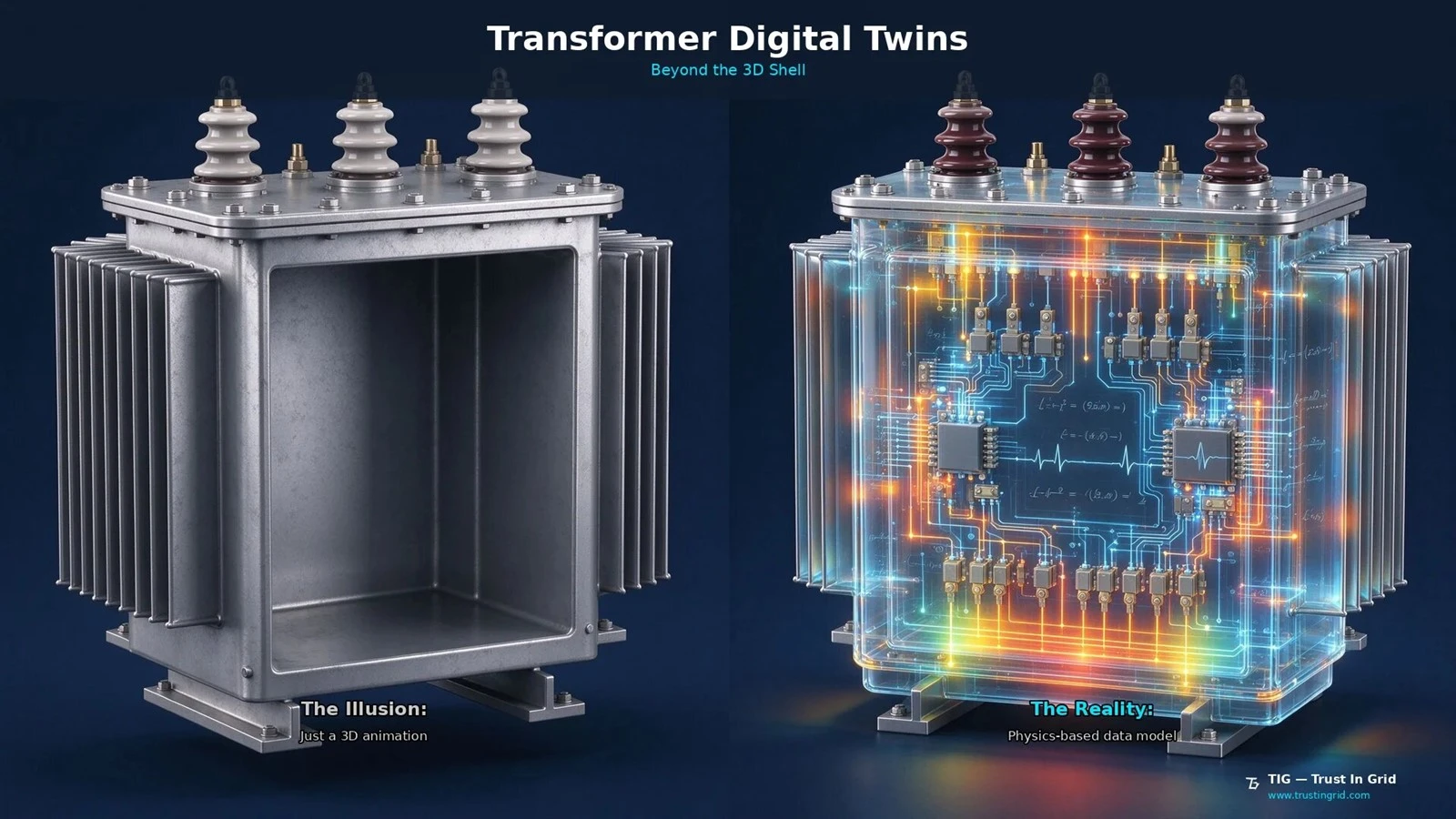
A true transformer digital twin shouldn't just be a 3D shell. It should be a data model that spans the entire lifecycle: from the electromagnetic calculations on the design drawing, to the core stacking in the manufacturing workshop, to decades of operating data, DGA analysis, and temperature records at the substation, and finally to the end-of-life assessment. Mapping all these physical events into a dynamic virtual model-that's what a digital twin is supposed to be.
This article skips the buzzwords. It's a practical look at what digital twins can actually do in transformer asset management, and where the technology currently stands.
1. Stop Staring at the 3D Model
Many people's first impression of a digital twin is a 1:1 3D model of the transformer, with colorful sensor data flashing all over it.
That's not a digital twin. That's a 3D animation with a data dashboard.
What is the core of transformer asset management? It's figuring out how much longer the equipment can last, when to repair it, and when to replace it. Therefore, a useful digital twin must be built on physics-based models combined with data-driven logic.
For example. The biggest fear for a transformer is insulation aging. The lifespan of the insulation paper depends on the hot-spot temperature. How does the digital twin calculate this? It can't just rely on the thermometer stuck on the outside of the tank. It needs to take the designed electromagnetic parameters and winding geometry, combine them with real-time load curves and ambient temperatures, and run a thermodynamic simulation inside the virtual model. It calculates the temperature of the absolute hottest point inside the winding at this exact moment, and then estimates the degree of polymerization (DP) drop in the insulation paper.
This is calculated by a mathematical model, not displayed by a 3D shell. The 3D model on the screen is just the skin; the thermodynamic, electromagnetic, and aging models behind it are the soul of the digital twin.
2. The Full Lifecycle: From Design to Retirement
A true digital twin should start working before the physical transformer even exists.
During the design phase, the twin is a simulation tool used to run short-circuit currents, optimize leakage flux distribution, and calculate temperature rise. Once the physical unit is built, the manufacturing test data (like partial discharge tests and lightning impulse results) are fed into the twin as its initial health baseline.
When the transformer arrives on site, the twin starts receiving real-time sensor data. Online DGA, PD, vibration, oil temp. It is no longer a static drawing model, but a dynamic system that ages right alongside the physical transformer.
This is where its value peaks. It doesn't just tell you "what's wrong right now." It tells you "if you keep running it at full load like this, what will happen three years from now."
When the transformer faces retirement, the twin's data is the most valuable asset. The unit ran for 30 years. How many overloads did it experience? How many times did the temperature exceed limits? This historical data reflects its true health more accurately than any offline test. The teardown data after retirement can then be used to calibrate new design models, closing the loop.
3. Data Comparison: Traditional vs. Digital Twin Asset Management
| Dimension | Traditional Asset Management | Digital Twin Asset Management |
|---|---|---|
| Data Source | Periodic test reports, paper ledgers | Real-time sensor data + historical tests + design parameters |
| Condition Assessment | Static snapshot (good or bad right now) | Dynamic simulation (how it was yesterday, how it will be tomorrow) |
| Aging Prediction | Empirical formulas based on age | Thermodynamic model predictions based on real-time load and temp |
| Fault Troubleshooting | Relies on expert experience and offline tests | Multi-source cross-validation, automated fault localization |
| Decision Support | Fixed-cycle maintenance or run-to-failure | Predictive maintenance and life extension based on actual health |
4. The Biggest Roadblocks: Data Quality and Standards
If digital twins are technically feasible, why haven't they scaled up yet?
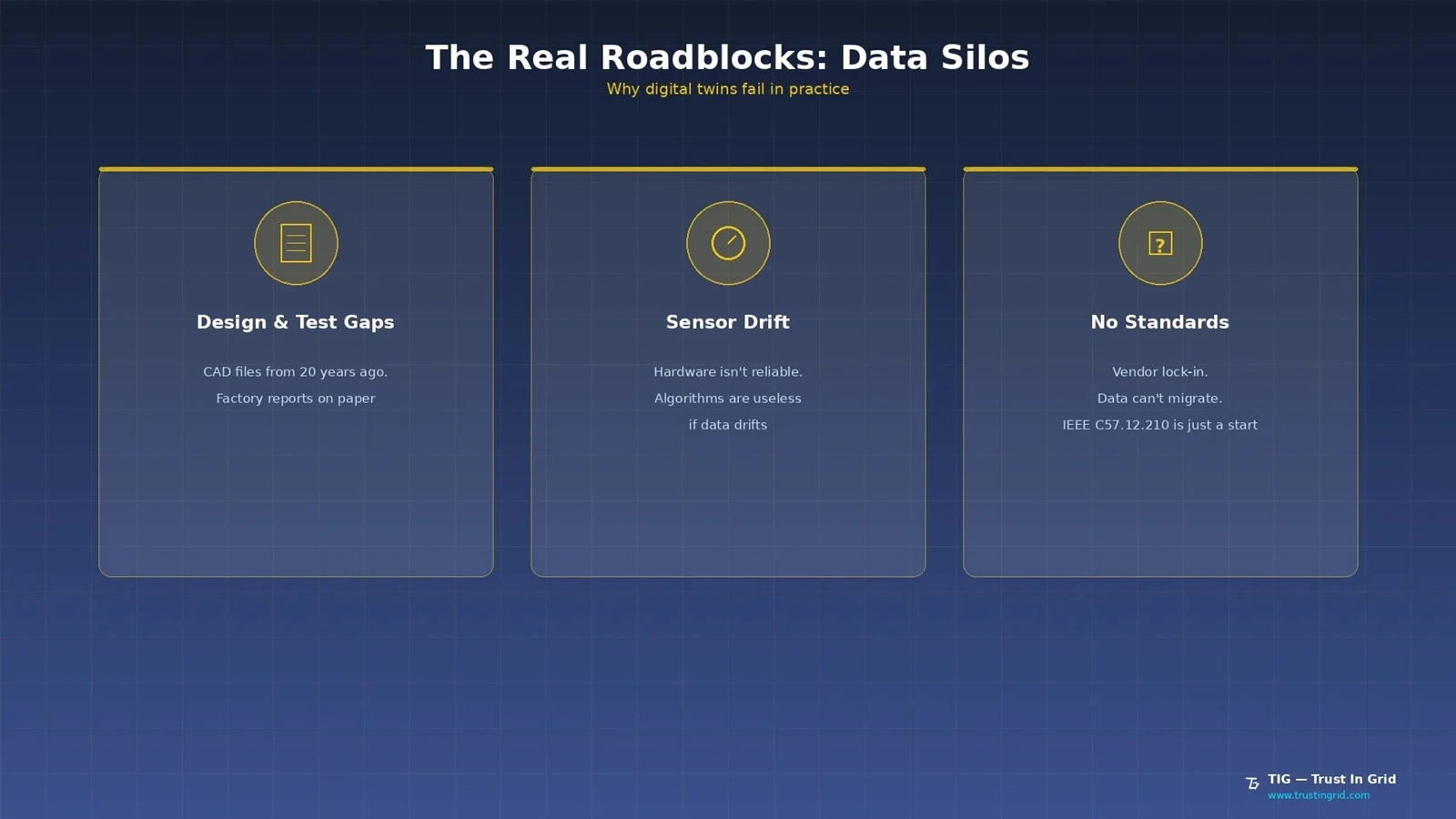
The first roadblock is data gaps. Transformers are long-life assets. The design drawings are CAD files from 20 years ago. Factory test reports are on paper. Operating records are scattered across different systems. The sensors were only added in the last few years. Cleaning, aligning, and integrating this decades-spanning data into one digital twin model is a massive engineering task. Many digital twin projects don't die because the model isn't accurate; they die because the data can't be put together.
Then you have sensor issues. No matter how accurately the twin calculates in the virtual world, if the DGA data coming back from the field has drifted, the result is wrong. This goes back to the previous point: if the hardware isn't reliable, the algorithms are useless.
And of course, the lack of standards. Currently, there is no unified international standard (like IEEE or IEC specs) for transformer digital twins. Twins built by different manufacturers aren't interoperable. If you switch vendors or software, the data you've accumulated can't come with you.
However, IEEE is starting to pay attention. IEEE C57.12.210-2022 addresses standard requirements for power transformer life cycle management, emphasizing data consistency and interoperability across design, manufacturing, and O&M. This provides at least a reference framework for the data foundation of digital twins.
5. Where It Makes Sense Right Now
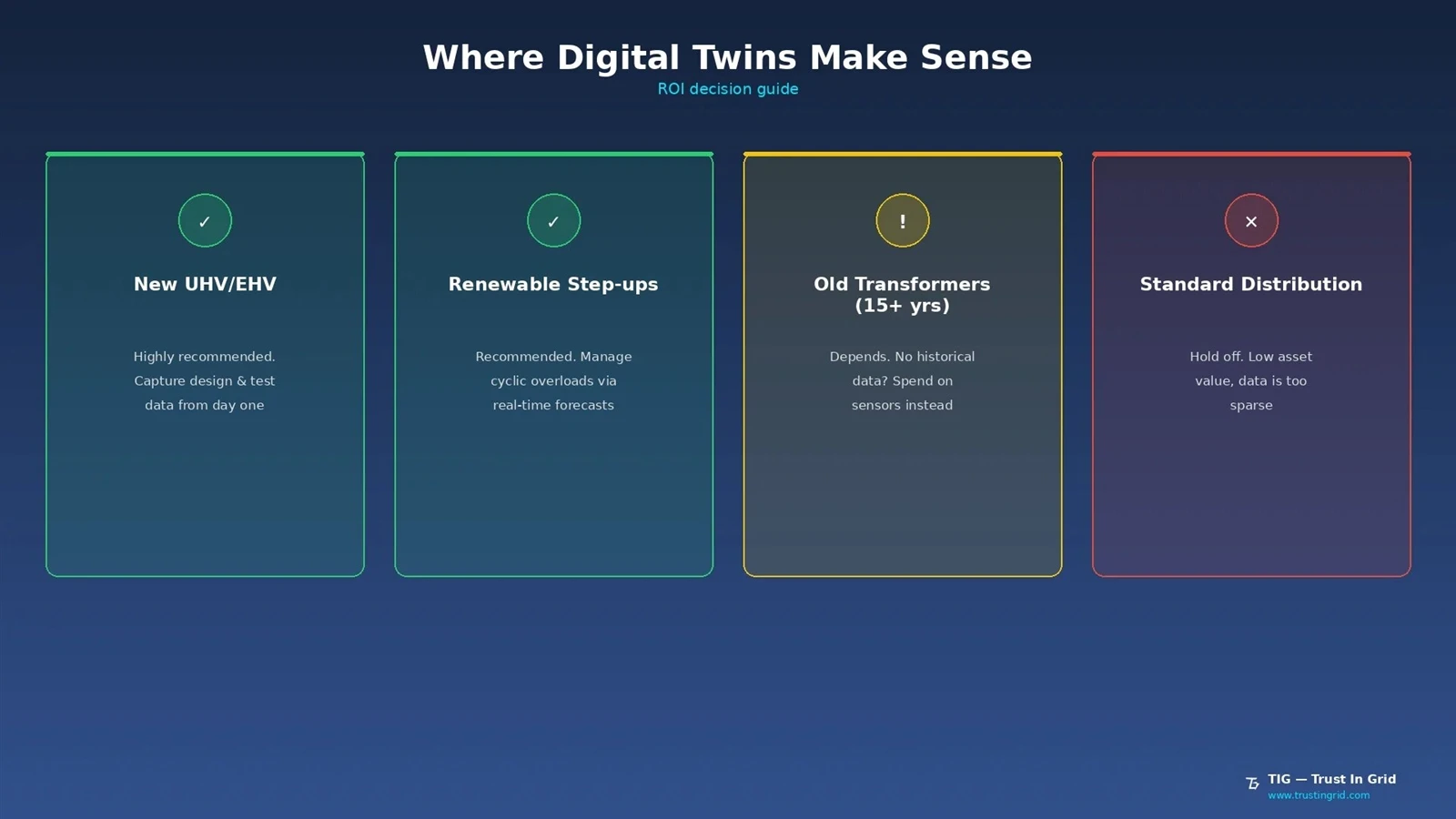
New UHV/EHV hub transformers: Highly recommended. These assets cost a fortune and impact grid security. When the equipment leaves the factory, digitize the design model, electromagnetic calculations, and factory test data to establish the initial digital twin foundation. Combined with subsequent real-time monitoring, this maximizes the safe operating life of the asset.
Renewable (Wind/PV) step-up main transformers: Recommended. Renewable duty cycles swing wildly. Transformers face constant power flips and cyclic overloads. Using the twin combined with renewable output forecasts can evaluate lifespan consumption in real-time and guide dispatch strategies (like when to curtail output slightly to let the transformer breathe).
Old transformers (15+ years in service): Depends. If there are no historical design parameters and no factory data, forcing a digital twin now doesn't make much sense. Better to spend the money beefing up online monitoring. Old equipment relies on measured data; only new equipment gets the full twin foundation.
Standard distribution transformers: Hold off. The cost is too high, the data is too sparse, and the unit value is too low. Completely unnecessary.
We build transformers and supply core materials. If you are evaluating transformer designs or specifications for smart asset management-whether it's ensuring data traceability from core manufacturing, or integrating advanced monitoring during the build phase-send us your details. Transformer type, voltage level, data requirements, timeline. You will get a straight answer.
TIG - Trust in Grid
www.trustingrid.com
asia@trustingrid.com
References
[1] Digital Twin for Power Transformers: A Review of Technologies and Applications, IEEE Transactions on Power Delivery, 2023.
[2] IEEE Std C57.12.210-2022, IEEE Standard for Standard Requirements for Power Transformers - Life Cycle Management, IEEE Standards Association.
[3] From Design to Retirement: The Role of Digital Twins in Transformer Asset Management, CIGRE Science & Engineering, 2024.
[4] Predictive Modeling of Transformer Insulation Aging Using Real-Time Digital Twins, IEEE Transactions on Dielectrics and Electrical Insulation, 2022.
[5] Implementation of Digital Twin Technology in Substation Asset Management: Challenges and Solutions, IEEE Access, 2023.
[6] Research on Digital Twin Technology Framework and Key Technologies for Power Transformers, Power System Technology, 2023.